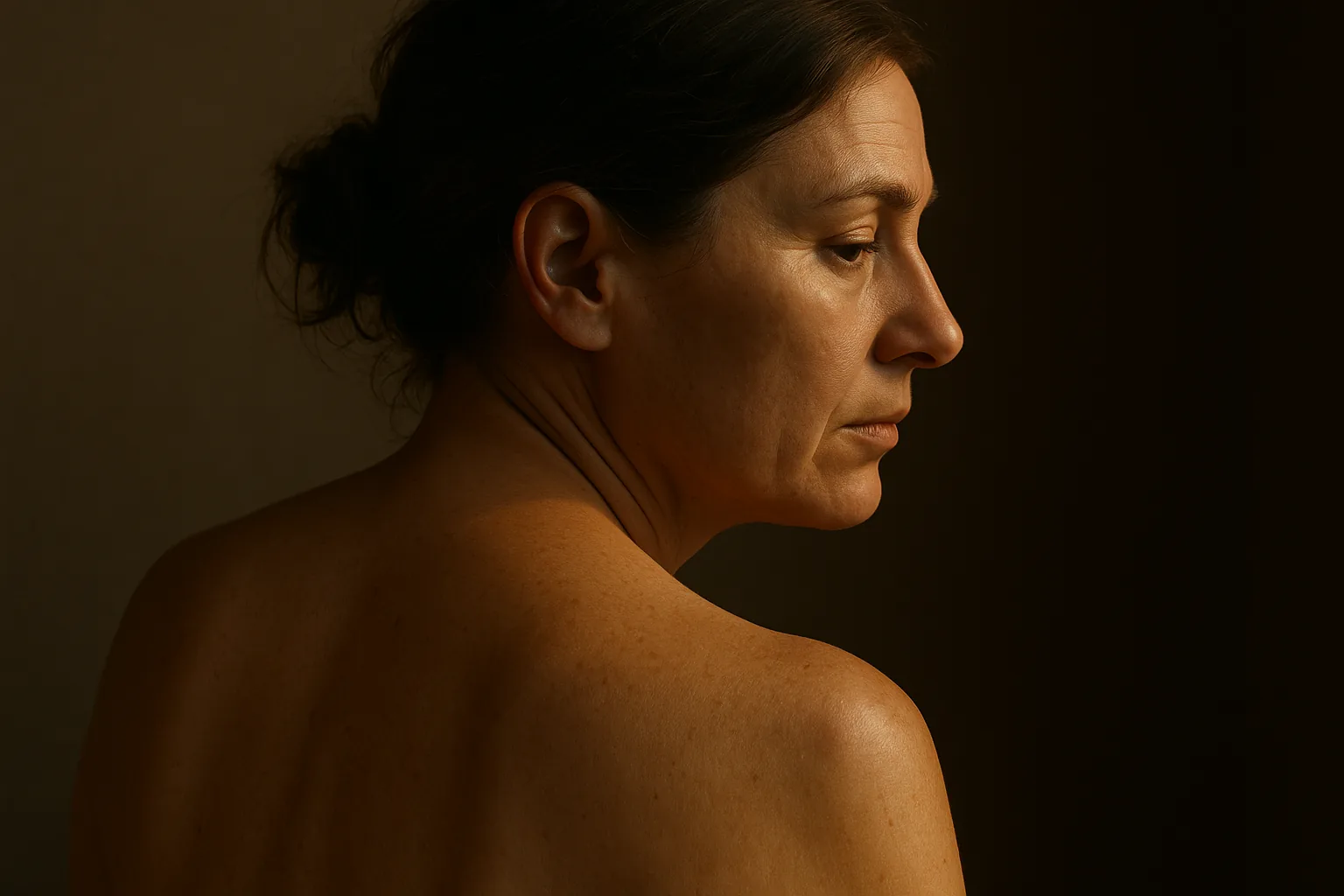
What are jowls?
A jowl is the soft tissue that begins to sag below the jawline, so that the line which once looked sharp now reads as heavy or tired. The pouch itself usually sits just behind the chin, and the small hollow in front of it, the pre-jowl sulcus, is often what makes the sag visible before the sag itself does.
Jowling is part of normal facial ageing, and genetics, weight change and lifestyle all affect when it appears. Some people notice it in their late thirties, when bone begins to remodel and the ligaments of the face loosen. Others see nothing until much later.
What causes jowls?
Four things drive it, and most patients have more than one at once. This matters more than it sounds, because each one responds to a different treatment and none of them responds to all four.
- Bone resorption at the mandible. Bone is lost at the jaw angle and along the body of the jaw, which lowers the structural platform the soft tissue above it rests on.
- Fat pad descent. The deep fat compartments of the face deflate and slide downwards. Volume that once held a high cheek and a sharp jaw now pools at the jowl.
- Skin laxity. Collagen and elastin break down, so the skin envelope loosens over the structure beneath it and definition softens even where bone and fat are intact.
- Masseter bulk. Chronic clenching enlarges the chewing muscle and widens the jaw at the angle. A jaw that reads as wide is sometimes muscle rather than bone.
Each of these is explained in more depth, with the assessment that separates them, on our guide to jowls and a softening jawline.
Can jowls be treated without surgery?
Yes, for mild to moderate jowling. Non-surgical treatment will not do what a facelift does, because it does not remove skin. What it can do is rebuild the support that has been lost, tighten the skin envelope and reposition tissue, which for most patients at this stage is enough to restore a defined lower face.
The limitation is honest and worth stating plainly: where there is significant excess skin, surgery remains the better option, and many patients use non-surgical treatment to delay that point rather than to replace it.
Which treatment suits which cause
| What is driving it | What is treated | Where to read more |
|---|
| Lost bony platform, hollowing at the pre-jowl sulcus | Hyaluronic acid volume enhancement placed at depth along the jaw and chin, and in the cheek to relieve the downward pull | Jawline contouring |
| Deflation with early laxity, where structure needs to be rebuilt rather than padded | A collagen biostimulator, which gives structure on the day and activates the skin's own collagen production afterwards | Collagen biostimulator |
| Skin laxity with structure largely intact | Radiofrequency skin tightening, which heats the deeper layers so collagen fibres contract and new collagen is built | XERF skin tightening |
| Tissue that has descended from where it used to sit | A thread lift, which repositions the tissue of the lower face and jowl | Thread lift |
| A wide jaw created by an enlarged chewing muscle | Wrinkle relaxer injections into the masseter to reduce muscle bulk | Face slimming and teeth grinding treatment |
This is the part a consultation is for. Treating laxity with volume makes a face look fuller without looking defined, and treating lost bone with a device does nothing at all, so the assessment that decides which of the four is dominant is the treatment decision.
How volume enhancement improves a jowl
Two placements do the work. The first supports the cheek and the mid face, so the downward pull that gathers at the jowl is relieved from above. The second rebuilds the jaw itself, filling the pre-jowl hollow and sharpening the angle so the pouch no longer reads as a separate shape.
Dr Rakib typically uses between two and six millilitres for a noticeable change in jawline definition, placed with cannula techniques to keep discomfort and downtime low. The volume is decided by anatomy, not by a package. Most patients see a clear improvement immediately, it continues to settle over the following weeks, and results last up to two years.
How skin tightening improves a jowl
XERF is the device used here for laxity. It delivers dual frequency monopolar radiofrequency, 6.78 MHz for the superficial and mid dermal layers and 2 MHz for deeper tissue, with impedance measured in real time and the surface cooled as the energy goes in, so there are no needles and no downtime. The depth it reaches is the point: energy arrives at the SMAS, the same layer a surgeon addresses in a deep plane facelift.
Existing collagen contracts within days, which gives an early lift, and new collagen builds from there, peaking at around two to three months. One session gives a meaningful result for mild to moderate laxity. Two sessions, eight to twelve weeks apart, suit more pronounced laxity. A maintenance session every twelve months holds it.
How long do the results last?
It depends on the layer being treated. Hyaluronic acid volume enhancement along the jaw lasts up to two years. A collagen biostimulator can last eighteen months or more, because part of the result is collagen your own skin has made. Radiofrequency results stabilise at around four to six months and are maintained with a session every twelve months. Masseter treatment is repeated periodically as muscle bulk returns.
Frequently asked questions
At what age do jowls start?
Commonly from the late thirties, when bone resorption begins and the facial ligaments loosen, though genetics and weight change move that in either direction. Some patients see no jowling until much later in life.
Can jowls be treated without filler?
Yes, where filler is not what the face needs. Skin laxity with intact structure is treated with radiofrequency skin tightening, descended tissue with a thread lift, and a jaw widened by muscle with masseter treatment. Which one applies is decided at assessment.
Will treating jowls make my face look fuller?
Not when the cause has been identified correctly. Volume is placed at depth, against bone and in the cheek, to rebuild support rather than to add bulk at the surface. Where laxity rather than deflation is the problem, volume is not the right treatment at all.
Is there any downtime?
Radiofrequency skin tightening has no downtime. Injectable treatments can cause bruising, swelling and tenderness for a few days, which is why we advise against booking anything new within a fortnight of an event that matters to you.
What does jowl treatment cost in Melbourne?
Current Therapeutic Goods Administration guidance means we cannot publish prices for cosmetic injectable treatments, so those are discussed at your consultation with a plan written for you. Device treatment is not restricted in the same way: XERF skin tightening is $2,800 for the full face, $3,800 for full face and neck and $1,500 for the neck alone, per session.
When is surgery the better option?
When there is significant excess skin. Non-surgical treatment supports, tightens and repositions, but it does not remove skin, and a patient who needs that is better served by a surgical opinion. Dr Rakib will say so at consultation rather than treat around it.
Have your jowls assessed
Dr Rakib Uddin (MBBS, Fellow ACCSM) teaches facial anatomy and has performed more than a thousand treatments at the Kew clinic. A jowl consultation establishes which of the four causes is dominant in your face, what each available route would and would not change, and what the plan would be.
Book a consultation or get in touch with Aesthetic Doctors Australia in Kew, Melbourne.