Aesthetic Doctors Australia

Menu

Where would you like to begin?

Facial volume assessment in Kew, Melbourne

Facial volume loss & hollowing, explained.

Cheeks, temples, jawline and chin lose structural volume gradually: bone remodels and the deep fat compartments deflate. The face does not so much wrinkle as deflate, and photographs usually notice before mirrors do. Restoring it well is a matter of restraint and placement.

Reviewed by Dr Rakib Uddin AHPRA MED0001936872

  • The cause identified before any treatment
  • Assessed by Dr Rakib and his team
  • Alternatives explained, including not treating
  • A clear pathway to the right option
Commissioned editorial study for this concern
Assessment with Dr Rakib

What's happening

Facial volume loss & hollowing: what is actually happening?

Facial volume loss is the gradual deflation of the face's structural layers. The deep fat compartments that give the cheek and temple their convexity thin with age, and the facial skeleton itself slowly remodels: the cheekbone loses projection, the jaw angle softens and the chin loses forward support. The skin, largely unchanged in area, has less to drape over, which reads as hollowing, shadowing and a tired look that sleep does not fix.

Weight loss adds to it: losing significant weight, at any age and by any means, thins the facial fat compartments along with everything else. Restoring volume well means mapping which compartments have deflated and rebuilding them in proportion, not adding fullness wherever a shadow appears.

  • Two layers deflate

    Bone + fat

    The skeleton remodels while deep fat compartments thin.

  • Often unnoticed

    Temples first

    Temple hollowing changes the face's frame quietly.

  • The natural route

    Gradual builds

    Biostimulation restores support over weeks, not overnight.

The causes

Why does it happen?

Most cases come down to deep fat-pad deflation, bone remodelling at the cheek, temple, jaw and chin, significant or rapid weight loss, genetics, age-related skin change over reduced support. More than one is usually contributing at once, which is why the cause gets named before any treatment is suggested.

  1. Deep fat-pad deflation

    The face's deep fat sits in discrete compartments that deflate at different rates. The mid-cheek compartments usually go first, which is why hollowing starts high on the face.

  2. Bone remodelling

    The facial skeleton is not static: the eye sockets widen, the cheekbone loses projection and the jaw remodels with age. Soft tissue loses its scaffold from beneath.

  3. Significant weight loss

    Facial fat participates in any substantial weight change. Patients who lose a lot of weight, quickly or slowly, often notice the face deflate ahead of the body's other changes.

  4. Genetics and face shape

    Naturally lean faces carry less reserve in the deep compartments, so age-related deflation shows earlier and more sharply than in fuller faces.

  5. Skin change over reduced support

    Collagen decline means the skin drapes rather than springs back. Over a deflated platform, that draping is what creates shadows, folds and the hollow look.

The types

What are the different types?

There are 4 patterns worth telling apart, and the right plan depends on which one is yours.

  1. Cheek and mid-face hollowing

    Flattening of the mid-cheek; shadows below the cheekbone; the under-eye often looks worse than it is.

    Full face rejuvenation
  2. Temple hollowing

    The temples sink, narrowing the upper face and changing how the whole frame reads.

    Volume enhancement
  3. Jawline and chin deflation

    The jaw loses its clean line and the chin its projection; the lower face looks softer.

    Jawline contour
  4. Global deflation

    Several compartments thinning together, often after weight loss; needs staged whole-face planning.

    Collagen biostimulator

Which one is yours

Which one are you seeing?

Match what you notice in the mirror to a likely cause and the pathway worth discussing. It is a starting point, not a diagnosis: the assessment confirms it.

  1. If you notice

    “My face looks tired in photos even when I feel well rested”

    Possible cause

    Mid-face deflation casting shadow

    Pathway

    Mapping the cheek compartments, then staged structural restoration

    Full face rejuvenation
  2. If you notice

    “My temples look sunken and my face seems narrower up top”

    Possible cause

    Temple volume loss

    Pathway

    Conservative temple restoration as part of a whole-face plan

    Volume enhancement
  3. If you notice

    “My jawline and chin have lost their definition”

    Possible cause

    Skeletal and fat change at the lower face

    Pathway

    Structural support at the jaw and chin

    Jawline contour
  4. If you notice

    “I have lost a lot of weight and my face has deflated with it”

    Possible cause

    Global fat-compartment thinning

    Pathway

    Gradual, staged rebuilding with biostimulation where suitable

    Collagen biostimulator

What treats it

Which treatment actually addresses it?

The one that matches your cause. Each pathway below pairs a driver with the plan Dr Rakib Uddin would discuss for it: same concern, different cause, different treatment.

  1. When one or two compartments have deflated

    Targeted volume restoration in the deflated compartments, in proportion to the rest of the face. Placement matters more than quantity: the goal is support the eye cannot locate.

  2. When the deflation is structural and widespread

    A biostimulator rebuilds support gradually as your own collagen responds over 8–12 weeks, which suits global deflation: the change arrives slowly, looks like recovery rather than treatment, and lasts 12–18+ months.

  3. When the lower face carries most of the loss

    Jaw and chin support is rebuilt at the bone level, where the loss actually happened. Restoring the frame often improves adjacent concerns, the jowl and marionette area among them, without touching them directly.

  4. When volume loss sits alongside skin and line changes

    Deflation rarely travels alone. A staged multi-modal plan across 3–9 months addresses volume, skin quality and lines in the right order instead of overfilling one layer to compensate for another.

Prevention

What slows it down?

The habits below protect the result of any treatment, and slow the concern when it is still early. None of them replace assessment; all of them help.

  • Keep weight steady where you can

    Repeated large weight swings cycle the facial fat compartments and accelerate the deflated look. Stability protects facial volume better than any topical.

  • Sun protection

    UV damage degrades the collagen that lets skin sit well over reduced volume. SPF every day keeps the draping layer resilient.

  • Start conservatively, stay conservative

    If you choose treatment, gradual staged restoration ages better than dramatic correction. It is much easier to add support next year than to dissolve an overfilled face.

  • Strength and nutrition basics

    Adequate protein and resistance training help preserve the muscle layer of the face's support system, particularly through weight loss and after menopause.

Common beliefs

What do people get wrong about it?

The beliefs patients most often arrive with, next to what is actually true.

  • Commonly believed

    “Volume loss is just about getting older”

    In practice

    Age is one driver among several. Weight loss, genetics and skeletal remodelling all contribute, which is why some faces deflate at thirty-five and others barely change at sixty.

  • Commonly believed

    “Filler makes every face look puffy”

    In practice

    Overfilled faces are a placement and quantity failure, not a property of volume restoration. Support placed deep, in the compartments that actually deflated, restores structure without changing the face's character.

  • Commonly believed

    “The face should be restored to how it looked at twenty-five”

    In practice

    Chasing a decades-old photograph is how proportion goes wrong. Good restoration works with the face in front of the mirror today, rebuilding support so it looks rested, not rewound.

In consultation

Volume is architecture: rebuild the platform quietly and the face simply looks rested.

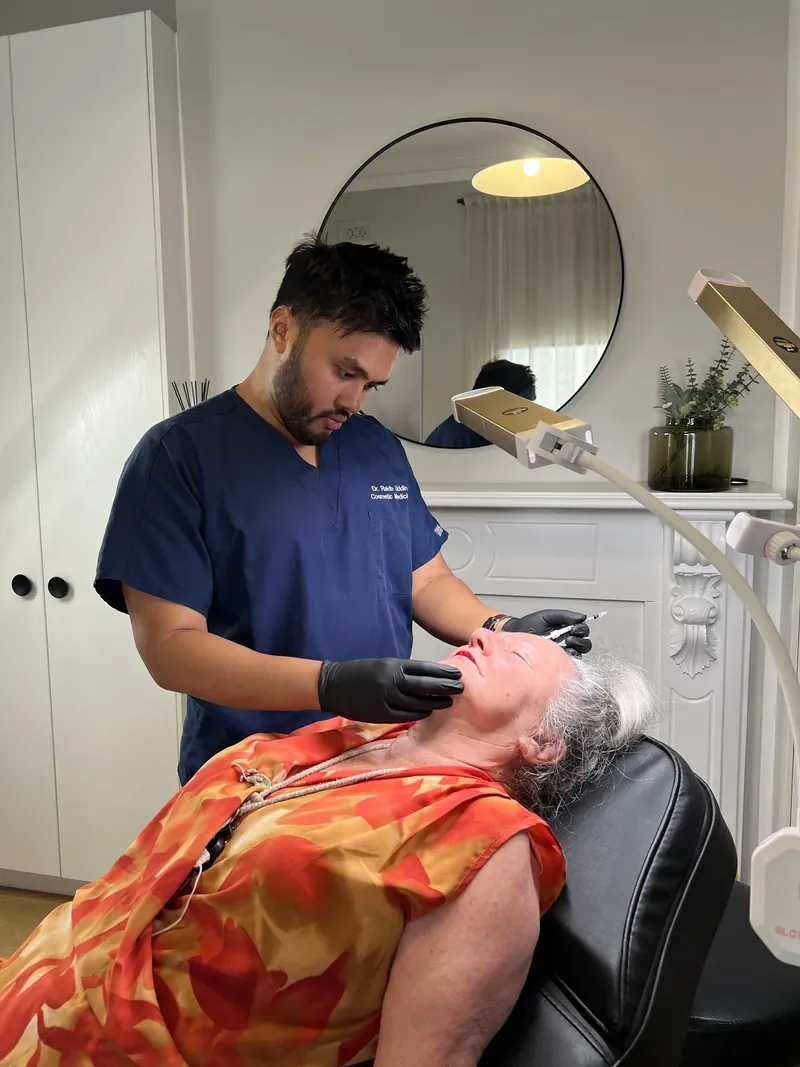
Cause before treatment: how Dr Rakib Uddin approaches facial volume loss & hollowing.

Dr Rakib Uddin, cosmetic doctor and founder of Aesthetic Doctors Australia

Your doctor

Dr Rakib Uddin

Cosmetic Doctor & Founder

  • MBBS (Qld)
  • BMedSci (Hons)
  • Dip. Surgical Anatomy
  • Fellow ACCSM

AHPRA MED0001936872

Every consultation for facial volume loss & hollowing is performed by Dr Rakib and his team: never delegated to a non-medical injector.

Dr Rakib Uddin is a Melbourne-based cosmetic doctor with formal surgical-anatomy training and over a decade in medicine. He performs every consultation, treatment and review at Aesthetic Doctors Australia personally, and trains other doctors in advanced injectable technique at Derma Medical Academy.

“If a treatment isn't right for you, I'll tell you. Every plan is built around your anatomy, not a template, and the goal is always a refreshed version of you, not a new face.”
  • Listen to your concern in full
  • Comprehensive medical and aesthetic assessment
  • Step-by-step treatment plan: single session or staged
  • Full discussion of risks, limitations and alternatives
  • Decline to treat when a procedure would do more harm than good
About the practice

Expert questions

The questions worth asking about facial volume loss & hollowing.

The questions that come up in the room, answered the way Dr Rakib answers them.

How do I know if my concern is volume rather than skin?

A useful sign: volume loss shows as shadows, flattening and a tired look that changes with lighting, while skin-quality change shows as texture, crepiness and fine lines up close. Most faces past forty have some of both, and the assessment maps how much of each yours carries.

What would a treatment plan actually involve?

Assessment first, including which compartments have deflated and photographs for planning. Then a staged plan: structural restoration where the loss is, usually across more than one visit, with review built in. The consultation is $75, redeemed against your treatment if you go ahead.

How is a biostimulator different from ordinary filler here?

A volume enhancement product restores support immediately and holds it. A collagen biostimulator adds some immediate volume, then prompts your own collagen to build over 8–12 weeks, suiting gradual, widespread deflation. Many plans use each where it works best; the assessment decides the mix.

I have lost a lot of weight. Should I wait until my weight settles?

Usually yes, or at least until the trajectory is stable. Restoring a face that is still changing means correcting a moving target, and product decisions made mid-loss can look wrong a year later. Assessment can still happen now, with treatment staged sensibly.

How long does restored volume last?

Volume enhancement work typically holds 12–18 months depending on the area. Biostimulator results build over 8–12 weeks and last 12–18+ months. Reviews are part of the plan, and top-up needs are usually smaller than the initial restoration.

Consultation first

Understand the cause. Then choose the pathway.

A consultation with Dr Rakib Uddin works out what's driving facial volume loss & hollowing in your case, then matches the right treatment, an alternative, or no treatment at all.

1167 Burke Road, Kew VIC 3101

Important treatment information

All information on this page is general in nature and is not a substitute for a medical consultation. Any before-and-after images shown are for illustrative purposes only and do not guarantee individual outcomes. Treatments performed by Dr Rakib Uddin (AHPRA MED0001936872) vary based on each patient's unique anatomy, medical history and needs. All cosmetic injectable treatments carry risks; a consultation is required prior to any treatment to assess suitability, discuss risks and alternatives, and establish realistic expectations.

Consultation Facial volume loss & hollowing
Book