Aesthetic Doctors Australia

Menu

Where would you like to begin?

Chin and profile assessment in Kew, Melbourne

A weak chin & recessed profile, explained.

A weak chin is a skeletal proportion, not an ageing change: the chin sits behind the line the nose and lips expect it to meet. It quietly shapes how the jaw, neck and even the nose read. Projection can be built non-surgically, in millimetres, with the whole profile in view.

Reviewed by Dr Rakib Uddin AHPRA MED0001936872

  • The cause identified before any treatment
  • Assessed by Dr Rakib and his team
  • Alternatives explained, including not treating
  • A clear pathway to the right option
Commissioned editorial study for this concern
Assessment with Dr Rakib

What's happening

A weak chin & recessed profile: what is actually happening?

A weak or recessed chin is a chin that sits behind the vertical line a balanced profile draws down from the lips. It is skeletal: the mandible and chin point developed that way, which is why the profile in question usually looks familiar from photographs at eighteen. It is one of the most common proportions patients notice without being able to name.

Because the chin anchors the lower third of the face, its position changes how everything around it reads. A recessed chin can make the nose look larger than it measures, blur the jaw-to-neck angle, create the look of submental fullness without much fat being present, and let the lower lip curl slightly outward. That is why chin work is planned from the whole profile, never from the chin alone.

  • Present from youth

    Skeletal

    A recessed chin is anatomy, not an ageing change.

  • Nose, lips, chin

    Whole profile

    The chin is judged against the features it balances.

  • Small moves, big reads

    Millimetres

    Chin projection works in tiny, deliberate increments.

The causes

Why does it happen?

Most cases come down to underlying jaw and chin bone development, genetics, bite pattern, age-related bone change adding to an existing tendency. More than one is usually contributing at once, which is why the cause gets named before any treatment is suggested.

  1. Skeletal development

    Chin projection is set by how the mandible and its chin point grew. A recessed chin is a normal anatomical variant, strongly hereditary, and no habit or exercise changes it.

  2. Bite pattern

    Some bite relationships, particularly where the lower jaw sits back relative to the upper, present as a recessed chin. Significant cases overlap with orthodontic territory, which assessment screens for.

  3. Age-related bone change

    The jaw remodels slowly with age, and a chin that always sat slightly back can appear to retreat further as its bony support reduces.

  4. Soft-tissue change over the bone

    Volume loss around the chin and pre-jowl area with age makes an existing skeletal tendency more visible, even though the bone itself has barely moved.

The types

What are the different types?

There are 4 patterns worth telling apart, and the right plan depends on which one is yours.

  1. Mild recession

    The chin sits just behind the balance line; the profile reads soft rather than short.

    Chin enhancement
  2. Recession with jawline blur

    Projection and jaw definition are both lacking; chin and jawline are planned together.

    Chin and jawline contour
  3. Recession read as double chin

    The missing projection makes the area beneath the chin look full; the chin, not the fat, is the finding.

    Assessment first
  4. Skeletal-scale recession

    A significantly retruded jaw, sometimes with bite involvement; beyond injectable correction.

    Discuss referral

Which one is yours

Which one are you seeing?

Match what you notice in the mirror to a likely cause and the pathway worth discussing. It is a starting point, not a diagnosis: the assessment confirms it.

  1. If you notice

    “In side-on photos my chin seems to disappear into my neck”

    Possible cause

    Recessed chin blurring the jaw-to-neck angle

    Pathway

    Profile analysis, then staged chin projection

    Chin projection
  2. If you notice

    “I have always felt my nose looks big, but only in profile”

    Possible cause

    Chin recession changing the nose's visual weight

    Pathway

    Assess chin and nose together before treating either

    Book a profile assessment
  3. If you notice

    “I look like I have a double chin even though I am slim”

    Possible cause

    Missing chin projection, not submental fat

    Pathway

    Projection first; the fullness often resolves visually with it

    Chin and jawline contour
  4. If you notice

    “My lower jaw sits noticeably back and my bite has always been off”

    Possible cause

    Skeletal-scale recession with possible bite involvement

    Pathway

    Referral conversation; injectable work is not the right scale

    Discuss options

What treats it

Which treatment actually addresses it?

The one that matches your cause. Each pathway below pairs a driver with the plan Dr Rakib Uddin would discuss for it: same concern, different cause, different treatment.

  1. When the chin needs forward projection

    Chin enhancement is Dr Rakib's treatment of choice for this concern: structured product placed on and around the chin point builds projection in controlled millimetres, checked against the profile line at every step. Results typically hold 12–18 months.

  2. When chin and jawline are both under-defined

    Projection without a jawline to carry it looks odd, so the two are planned as one structure. A biostimulator can add durable support along the jaw where a gradual build is preferred.

  3. When the recession reads as submental fullness

    Restoring projection redraws the chin-to-neck geometry, and the apparent fullness often reduces with it. Genuine submental fat, if present, is a separate finding with its own plan, assessed rather than assumed.

  4. When the recession is skeletal in scale

    Beyond a certain distance, filler chasing a skeletal gap means large volumes doing a bone-shaped job badly. Genioplasty and orthognathic pathways exist for exactly this, and the assessment says so when they are the better answer.

Where to go next

The treatment guides worth reading.

Each guide explains how the treatment works, who it suits, recovery and cost. The right one for your case is confirmed at assessment, not assumed online.

Prevention

What slows it down?

The habits below protect the result of any treatment, and slow the concern when it is still early. None of them replace assessment; all of them help.

  • There is nothing to prevent

    A recessed chin is anatomy, not deterioration: no habit caused it and none will change it. What deserves attention is the choice of correction, not prevention.

  • Assess before the nose, not after

    Patients considering nose work should have the chin assessed first: correcting chin projection often changes how much nose correction, if any, still feels necessary.

  • Protect the area's soft tissue

    Sun protection and general skin care keep the soft-tissue envelope over the chin resilient, which matters more as age-related bone change arrives on top of the baseline.

  • Choose restraint over transformation

    Chin work that respects your face's proportions ages well. Projection built to chase a trend, or another person's profile, is the version patients later want dissolved.

Common beliefs

What do people get wrong about it?

The beliefs patients most often arrive with, next to what is actually true.

  • Commonly believed

    “A weak chin means jaw exercises are needed”

    In practice

    No exercise, chewing gum included, moves the chin point forward. The masseter muscles can enlarge with training, which widens the jaw sideways; projection is skeletal and changes only with structural correction.

  • Commonly believed

    “Chin filler gives everyone the same sculpted jaw”

    In practice

    Good chin work is planned from your own profile line and stops at balance. The uniform look comes from formula treatment; assessment-led work in millimetres is designed to be unremarkable.

  • Commonly believed

    “Only surgery can change a receding chin”

    In practice

    Skeletal-scale recession is surgical, and we say so. Short of that, structured filler restores projection convincingly for the majority who present, is reviewed at two weeks, and avoids an operation entirely.

In consultation

The chin sets the sentence the profile is trying to finish: a few millimetres change the whole reading.

Cause before treatment: how Dr Rakib Uddin approaches weak chin & recessed profile.

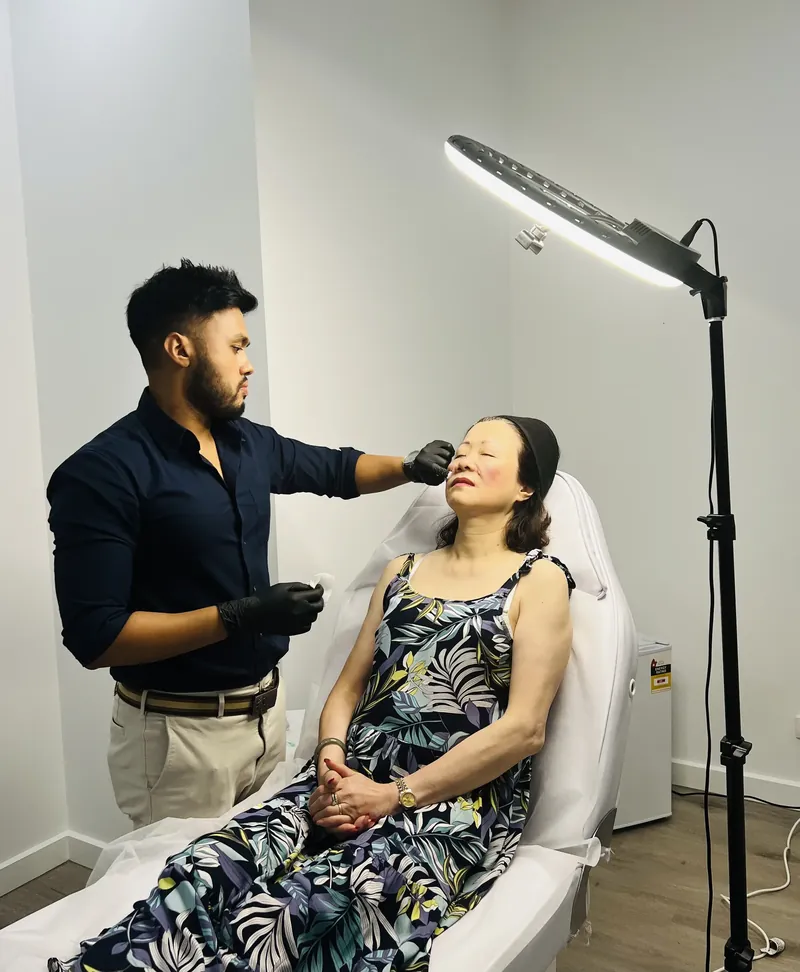
Dr Rakib Uddin, cosmetic doctor and founder of Aesthetic Doctors Australia

Your doctor

Dr Rakib Uddin

Cosmetic Doctor & Founder

  • MBBS (Qld)
  • BMedSci (Hons)
  • Dip. Surgical Anatomy
  • Fellow ACCSM

AHPRA MED0001936872

Every consultation for weak chin & recessed profile is performed by Dr Rakib and his team: never delegated to a non-medical injector.

Dr Rakib Uddin is a Melbourne-based cosmetic doctor with formal surgical-anatomy training and over a decade in medicine. He performs every consultation, treatment and review at Aesthetic Doctors Australia personally, and trains other doctors in advanced injectable technique at Derma Medical Academy.

“If a treatment isn't right for you, I'll tell you. Every plan is built around your anatomy, not a template, and the goal is always a refreshed version of you, not a new face.”
  • Listen to your concern in full
  • Comprehensive medical and aesthetic assessment
  • Step-by-step treatment plan: single session or staged
  • Full discussion of risks, limitations and alternatives
  • Decline to treat when a procedure would do more harm than good
About the practice

Expert questions

The questions worth asking about weak chin & recessed profile.

The questions that come up in the room, answered the way Dr Rakib answers them.

How do you decide how much projection to build?

From your profile, not from a template. The classic guide drops a line from the lips and reads the chin against it, adjusted for your features and what you want changed. Product is placed in small increments, rechecked side-on at each step, and the plan stops at balance rather than at maximum.

Will chin filler help what looks like my double chin?

Often, when the fullness is really a projection problem: bringing the chin forward redraws the line from jaw to neck and the area under the chin reads flatter. Where genuine submental fat is also present, that is a separate finding with its own options, and assessment tells the two apart.

Should I treat my chin or my nose first?

Assess both, then usually the chin. Chin projection changes the visual weight of the nose, so patients who correct the chin first sometimes revise what they want done to the nose, or drop it. Treating the nose first, with the chin unaddressed, risks solving the wrong half of the profile.

How long does chin projection last?

Structured chin and jawline work typically holds 12–18 months. The chin moves little, which helps longevity, and maintenance usually needs less product than the first build. A review at two weeks checks the result once settled.

What would make me unsuitable for injectable chin work?

Skeletal-scale recession, significant bite involvement, unrealistic projection goals, and certain medical or dental histories. The assessment screens for all of them, and when surgery or orthodontics is the better pathway, that is what will be recommended.

Consultation first

Understand the cause. Then choose the pathway.

A consultation with Dr Rakib Uddin works out what's driving weak chin & recessed profile in your case, then matches the right treatment, an alternative, or no treatment at all.

1167 Burke Road, Kew VIC 3101

Important treatment information

All information on this page is general in nature and is not a substitute for a medical consultation. Any before-and-after images shown are for illustrative purposes only and do not guarantee individual outcomes. Treatments performed by Dr Rakib Uddin (AHPRA MED0001936872) vary based on each patient's unique anatomy, medical history and needs. All cosmetic injectable treatments carry risks; a consultation is required prior to any treatment to assess suitability, discuss risks and alternatives, and establish realistic expectations.

Consultation Weak chin & recessed profile
Book