Aesthetic Doctors Australia

Menu

Where would you like to begin?

Marionette line and mouth-corner assessment in Kew, Melbourne

Marionette lines & mouth corners, explained.

Marionette lines run from the corners of the mouth down toward the chin, and they change how a resting face reads: neutral can start to look stern. The cause is usually lost support beside the chin plus downward muscle pull, which is why the plan rarely starts with filler in the line.

Reviewed by Dr Rakib Uddin AHPRA MED0001936872

  • The cause identified before any treatment
  • Assessed by Dr Rakib and his team
  • Alternatives explained, including not treating
  • A clear pathway to the right option
Commissioned editorial study for this concern
Assessment with Dr Rakib

What's happening

Marionette lines & mouth corners: what is actually happening?

Marionette lines are the creases that run from the corners of the mouth downward toward the jaw, named for the hinged mouth of a puppet. Alongside them sits the concern patients actually describe: mouth corners that have started to turn down, so the face at rest reads as tired or displeased when nothing is wrong.

Two mechanisms work together here. The tissue beside the chin, the pre-jowl area, loses volume and lets the corner fold inward, while the small depressor muscles at the mouth corner keep pulling downward against weakening support. Skin laxity then makes the crease visible at rest. Which mechanism dominates in your face decides the treatment, and it is different from patient to patient.

  • The real complaint

    Resting expression

    Patients describe looking cross when they feel fine.

  • Two mechanisms

    Pull + deflation

    Muscle drags the corner down while support beneath it thins.

  • Tighten, lift, support

    Sequenced

    Direct work on the line comes last, if at all.

The causes

Why does it happen?

Most cases come down to volume loss in the pre-jowl area beside the chin, downward pull of the mouth-corner muscles, ligament tethering, skin laxity, bone change at the jaw. More than one is usually contributing at once, which is why the cause gets named before any treatment is suggested.

  1. Pre-jowl volume loss

    The area between chin and jowl deflates with age and the mouth corner loses the platform beneath it. The crease forms where unsupported tissue folds.

  2. Downward muscle pull

    The muscles that draw the mouth corner down for expression keep working as support thins, so the corner sits lower at rest. Muscle activity is assessed at consultation because it changes the plan.

  3. Ligament tethering

    The mandibular ligament anchors skin near the chin. Tissue either side of that fixed point descends, which is why the crease takes its particular curved path.

  4. Skin laxity

    Thinner, looser skin shadows and creases more readily. In some patients laxity, rather than volume, is the main reason the line shows.

  5. Bone change at the jaw

    The lower jaw remodels slowly with age, reducing skeletal support for everything above it. It is one reason this area changes even in lean faces.

The types

What are the different types?

There are 4 patterns worth telling apart, and the right plan depends on which one is yours.

  1. Corner-led

    The mouth corners turn down; the line itself is still shallow.

    Assessment first
  2. Crease-led

    A defined line runs toward the chin, deepening in photographs and side light.

    Collagen biostimulator
  3. Laxity-led

    The whole lower face has loosened; the marionette area is one part of a wider change.

    XERF skin tightening
  4. Descent-led

    Jowling sits alongside the lines; tissue has moved rather than merely thinned.

    Thread lift

Which one is yours

Which one are you seeing?

Match what you notice in the mirror to a likely cause and the pathway worth discussing. It is a starting point, not a diagnosis: the assessment confirms it.

  1. If you notice

    “People ask if I am upset when I feel perfectly fine”

    Possible cause

    Corner-led: downward pull with early support loss

    Pathway

    Assessment of muscle pull against support; treatment matched to which dominates

    Book an assessment
  2. If you notice

    “A crease runs from my mouth corner toward my chin in every photo”

    Possible cause

    Crease-led: pre-jowl volume loss

    Pathway

    Structural support beside the chin rather than product in the line first

    Collagen biostimulator
  3. If you notice

    “The skin around my mouth and jaw feels looser generally”

    Possible cause

    Laxity-led change

    Pathway

    Skin tightening across the lower face

    XERF skin tightening
  4. If you notice

    “I can see early jowls forming either side of the lines”

    Possible cause

    Descent-led change

    Pathway

    Repositioning the descended tissue, then reassessing the lines

    Thread lift

What treats it

Which treatment actually addresses it?

The one that matches your cause. Each pathway below pairs a driver with the plan Dr Rakib Uddin would discuss for it: same concern, different cause, different treatment.

  1. When laxity is driving the change

    Tightening the skin envelope softens the crease and improves the whole lower-face area rather than one line. It is the least invasive rung on the ladder and the one this concern starts with.

  2. When tissue has descended alongside the lines

    Threads lift the descended tissue up and away from the mouth corner. Repositioning first means any later volume work needs less product and sits more naturally.

  3. When the pre-jowl area has lost structural support

    Rebuilding support beside the chin gives the mouth corner a platform again. The biostimulator's gradual collagen response suits an area where sudden change is very noticeable.

  4. When a defined crease remains after support is restored

    Small, conservative volumes soften what remains of the line itself. Dr Rakib sequences this last deliberately: filler placed into an unsupported marionette line tends to sink with the tissue around it.

Prevention

What slows it down?

The habits below protect the result of any treatment, and slow the concern when it is still early. None of them replace assessment; all of them help.

  • Sun protection, daily

    The skin component of this concern is largely photoageing. SPF 50+ protects the collagen this area depends on.

  • Skin quality maintenance

    Treatments and skincare that support collagen in the lower face slow the crease's progression from soft shadow to fixed line.

  • Address it while it is early

    A corner that is starting to fold responds to lighter treatment than a deep-set line with jowling beside it. Early, conservative work tends to age better here.

  • Care with repeated lip and chin work elsewhere

    Product repeatedly placed around the mouth without a plan for the whole area can add weight beside the corner. Anyone treating this region should be looking at the lower face as one unit.

Common beliefs

What do people get wrong about it?

The beliefs patients most often arrive with, next to what is actually true.

  • Commonly believed

    “Filler in the line is the treatment”

    In practice

    Sometimes it is the last step; it is rarely the first. When the corner has lost support or the tissue above has descended, product in the crease alone sinks with everything around it. Sequence matters more than syringes.

  • Commonly believed

    “Marionette lines mean the face is sagging everywhere”

    In practice

    Not necessarily. In some faces this area changes early while everything else holds. Assessment distinguishes a local support problem from generalised laxity, and the plans look different.

  • Commonly believed

    “Nothing non-surgical works here”

    In practice

    This area responds well to sequenced non-surgical treatment: tightening, lifting and structural support each have evidence and a defined role. What does not work is a single tool applied without a diagnosis.

In consultation

The mouth corner is a tug of war: restore the support and the corner stops losing.

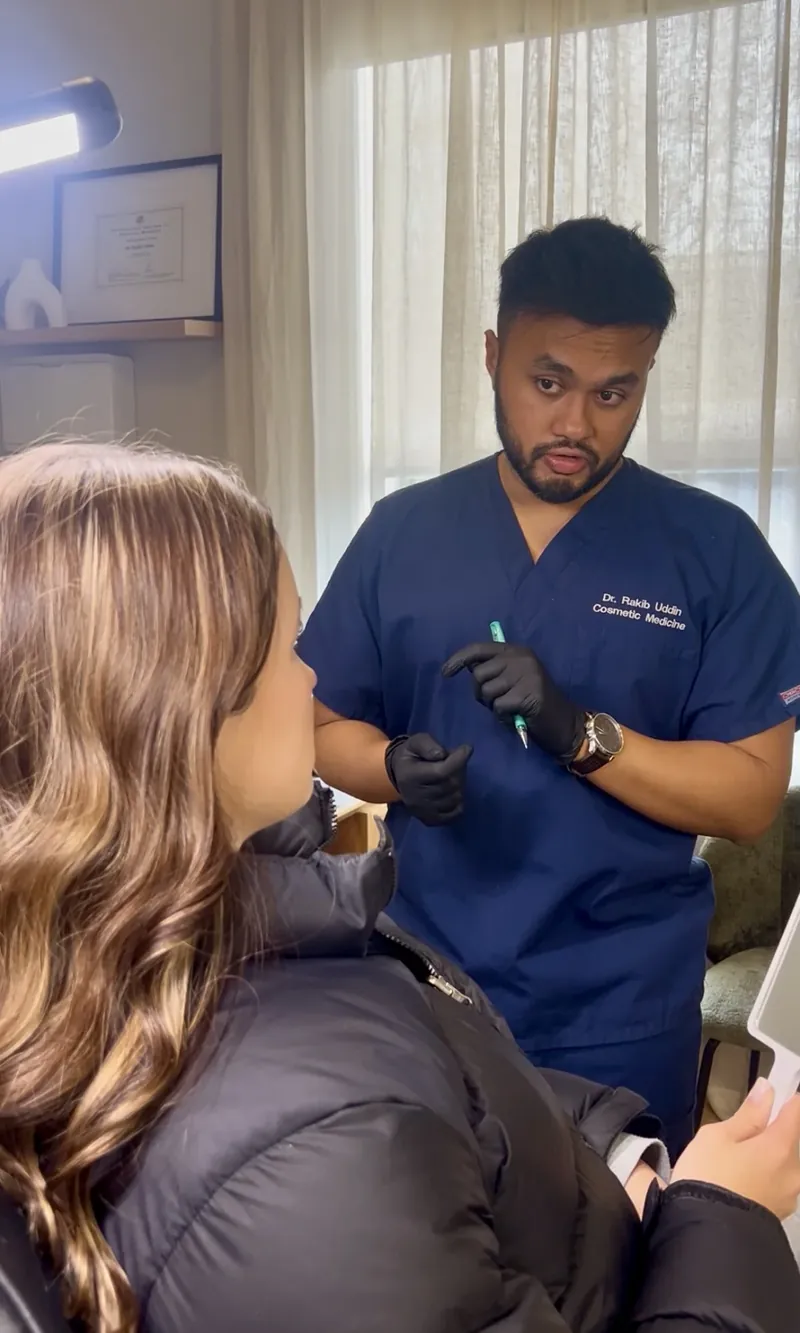
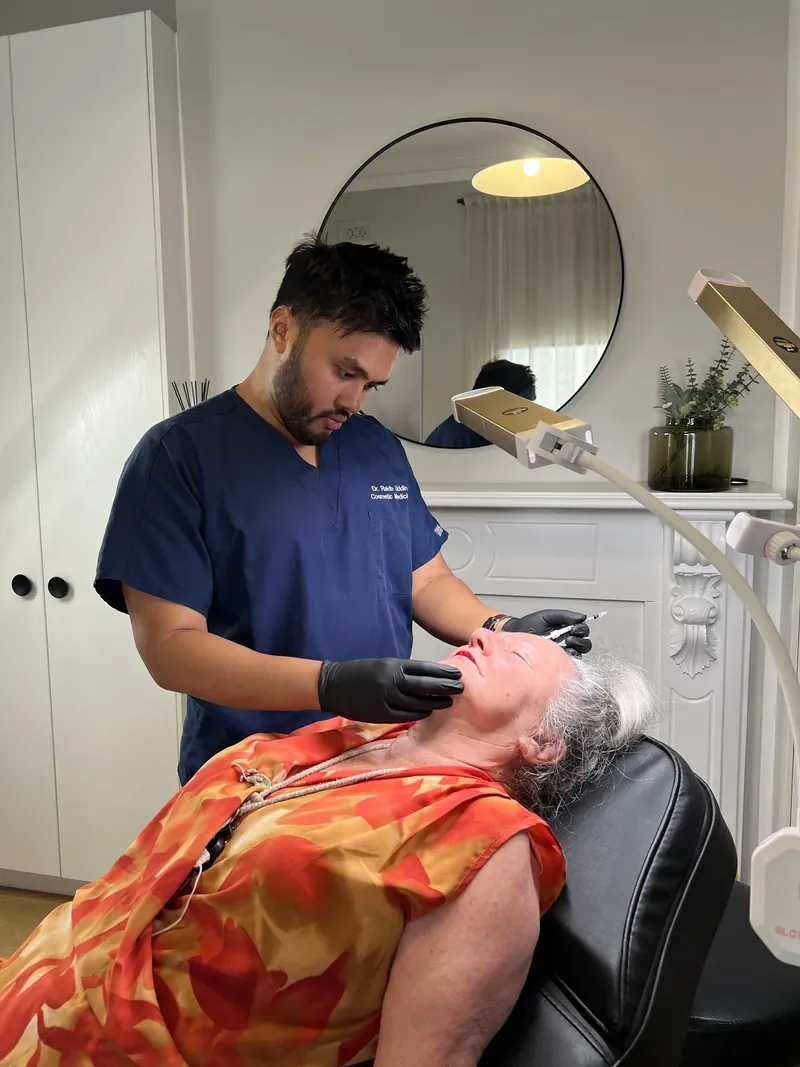
Cause before treatment: how Dr Rakib Uddin approaches marionette lines & mouth corners.

Dr Rakib Uddin, cosmetic doctor and founder of Aesthetic Doctors Australia

Your doctor

Dr Rakib Uddin

Cosmetic Doctor & Founder

  • MBBS (Qld)
  • BMedSci (Hons)
  • Dip. Surgical Anatomy
  • Fellow ACCSM

AHPRA MED0001936872

Every consultation for marionette lines & mouth corners is performed by Dr Rakib and his team: never delegated to a non-medical injector.

Dr Rakib Uddin is a Melbourne-based cosmetic doctor with formal surgical-anatomy training and over a decade in medicine. He performs every consultation, treatment and review at Aesthetic Doctors Australia personally, and trains other doctors in advanced injectable technique at Derma Medical Academy.

“If a treatment isn't right for you, I'll tell you. Every plan is built around your anatomy, not a template, and the goal is always a refreshed version of you, not a new face.”
  • Listen to your concern in full
  • Comprehensive medical and aesthetic assessment
  • Step-by-step treatment plan: single session or staged
  • Full discussion of risks, limitations and alternatives
  • Decline to treat when a procedure would do more harm than good
About the practice

Expert questions

The questions worth asking about marionette lines & mouth corners.

The questions that come up in the room, answered the way Dr Rakib answers them.

Why do my mouth corners turn down when I have not lost weight?

Because the change is structural rather than weight-related: the pre-jowl area beside the chin deflates with age, the jawbone remodels, and the corner muscles keep pulling down against that weakening support. Lean faces often show it earlier because there was less soft tissue in reserve.

Which treatment would I actually need?

It depends on what is driving your lines. Laxity points to skin tightening, descent to threads, deflation to biostimulator support beside the chin, and a residual crease to conservative volume enhancement. Most patients need one or two of those, not all four, and assessment decides which.

How long do results last?

XERF results mature over 3–6 months and are maintained with occasional sessions. Threads typically hold 12–18 months. Biostimulator support lasts 12–18+ months as your own collagen builds. Direct softening of the line is reviewed at two weeks and typically maintained annually.

Will treating this area change my smile?

It should not, and protecting expression is a design constraint of the plan. Doses and placement are chosen so the mouth moves normally; the goal is a neutral resting corner, not a lifted or frozen one. This is discussed openly at assessment.

Is this the same as jowls?

They are neighbours and often arrive together, but they are not the same. Jowls are descended tissue along the jawline; marionette lines are creases from the mouth corner. Some patients have one without the other, which is exactly what the assessment maps.

Consultation first

Understand the cause. Then choose the pathway.

A consultation with Dr Rakib Uddin works out what's driving marionette lines & mouth corners in your case, then matches the right treatment, an alternative, or no treatment at all.

1167 Burke Road, Kew VIC 3101

Important treatment information

All information on this page is general in nature and is not a substitute for a medical consultation. Any before-and-after images shown are for illustrative purposes only and do not guarantee individual outcomes. Treatments performed by Dr Rakib Uddin (AHPRA MED0001936872) vary based on each patient's unique anatomy, medical history and needs. All cosmetic injectable treatments carry risks; a consultation is required prior to any treatment to assess suitability, discuss risks and alternatives, and establish realistic expectations.

Consultation Marionette lines & mouth corners
Book