Nose filler and non-surgical rhinoplasty in Kew, Melbourne
Non-Surgical Nose JobMelbourne
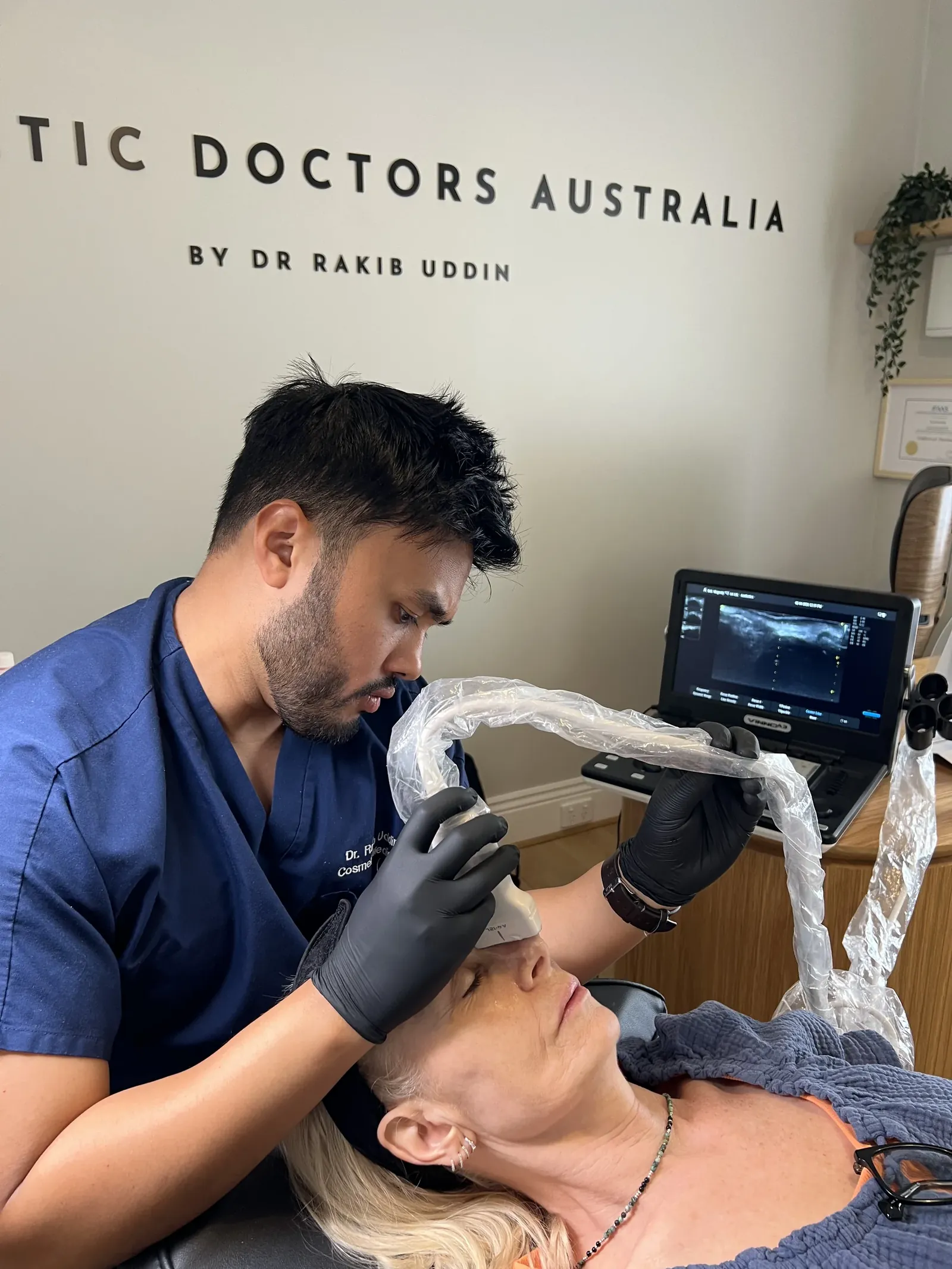
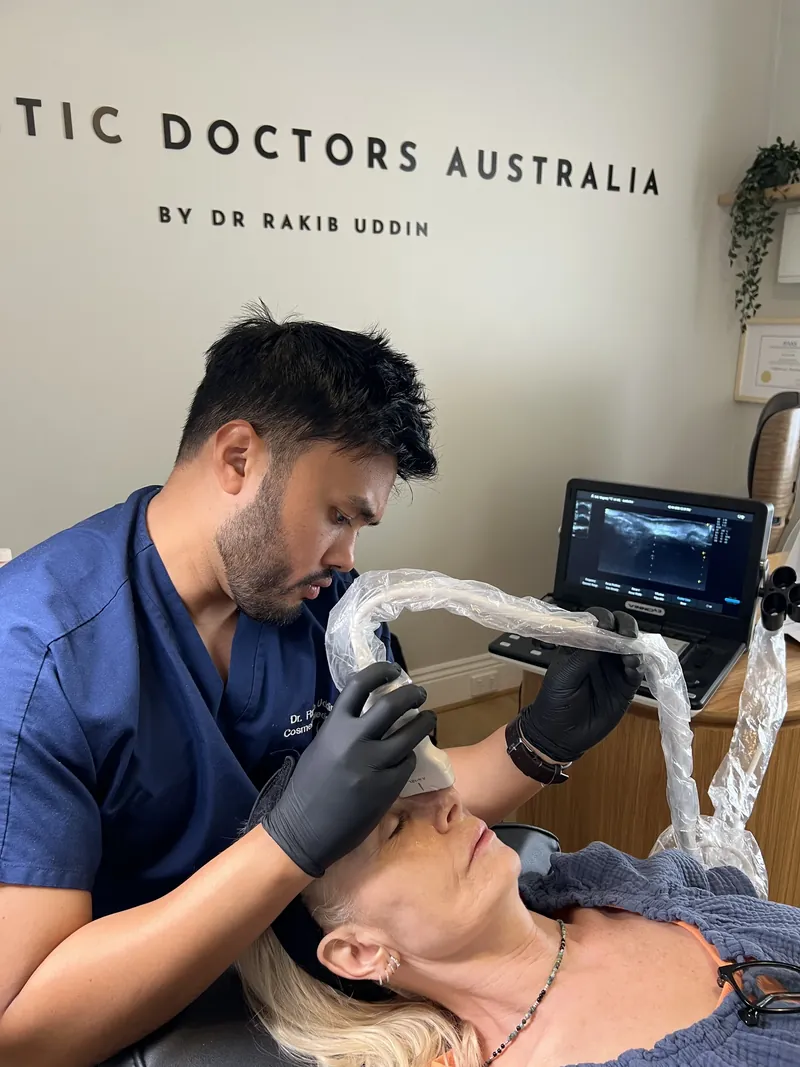
Doctor-performed nose reshaping with filler (refining the dorsum, lifting the tip, balancing asymmetry) without surgery, downtime or general anaesthetic. Dr Rakib performs an ultrasound scan of the nose before injecting, every time.
Non-surgical rhinoplasty uses precisely placed volume enhancement to camouflage a dorsal hump (by raising the surrounding profile), lift a drooping tip, straighten asymmetry, or build projection. The result is a different silhouette: not a different nose. The underlying bone and cartilage are untouched. Before any filler is injected, Dr Rakib performs an ultrasound scan of the nose to map the vessels in that individual anatomy.
It is reversible (filler can be dissolved), takes minutes rather than weeks of recovery, and lets patients see the proposed change before committing to surgical permanence. The limit: it adds, it doesn't subtract: a noticeably larger or wider nose is not what this treatment is for.
Many patients hold the result longer with repeat treatment.
If you change your mind
Reversible
Filler can be dissolved: surgery cannot be undone.
What it treats
What does non-surgical rhinoplasty treat?
Non-surgical rhinoplasty is most often planned for dorsal humps, drooping tip, asymmetry, under-projected bridge, post-surgical irregularities. The treatment only makes sense when it matches the cause of your concern; here is where it fits.
Genetics primarily, occasionally trauma. The most common patient concern is a small dorsal hump that profiles larger in photos than it feels in the mirror: the rest of the face often hasn't 'caught up' to the nose.
Treatment role
Filler above and below a hump straightens the profile so the silhouette reads smooth. Tip support lifts a drooping nose. Subtle adjustments rebalance proportions without touching structure.
The tip-supporting cartilage and ligaments weaken with time, and the tip drops, making the nose appear longer, with the tip dipping further on smiling.
Treatment role
A small amount of filler at the columella and tip can restore the projection lost to age, often with a noticeably refreshing effect on the whole profile.
Results
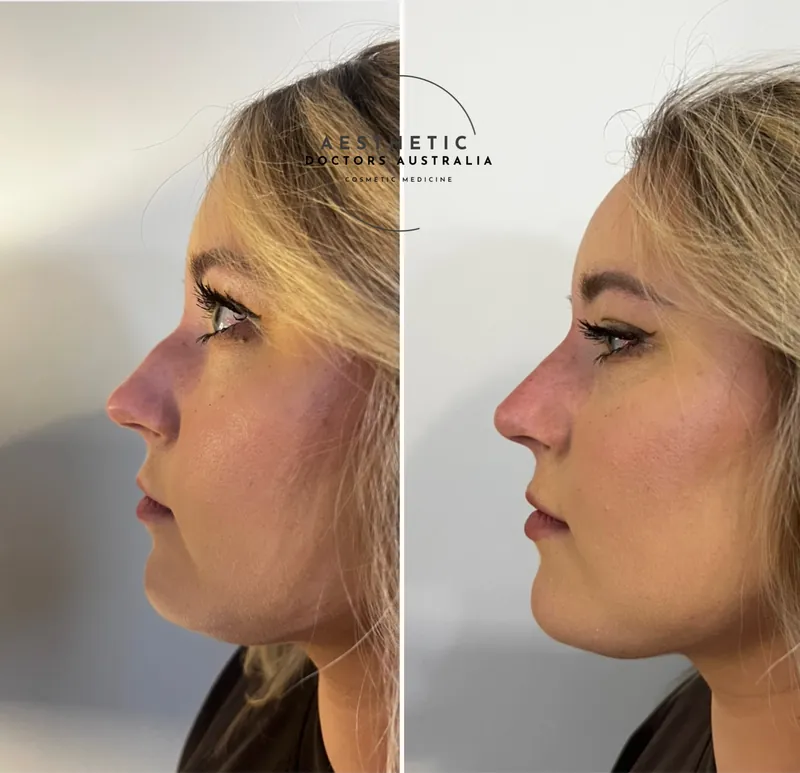
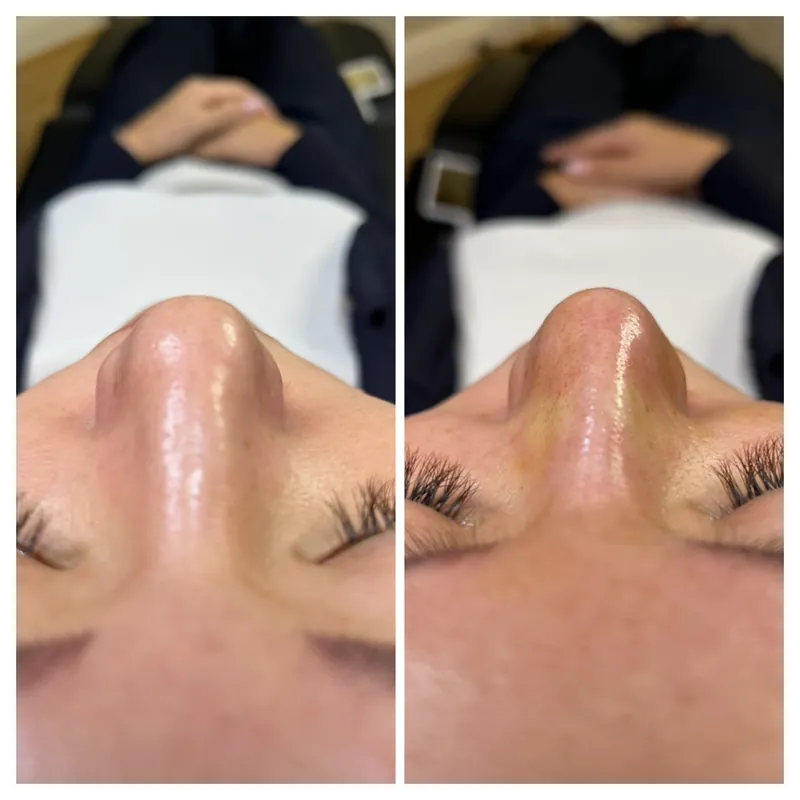
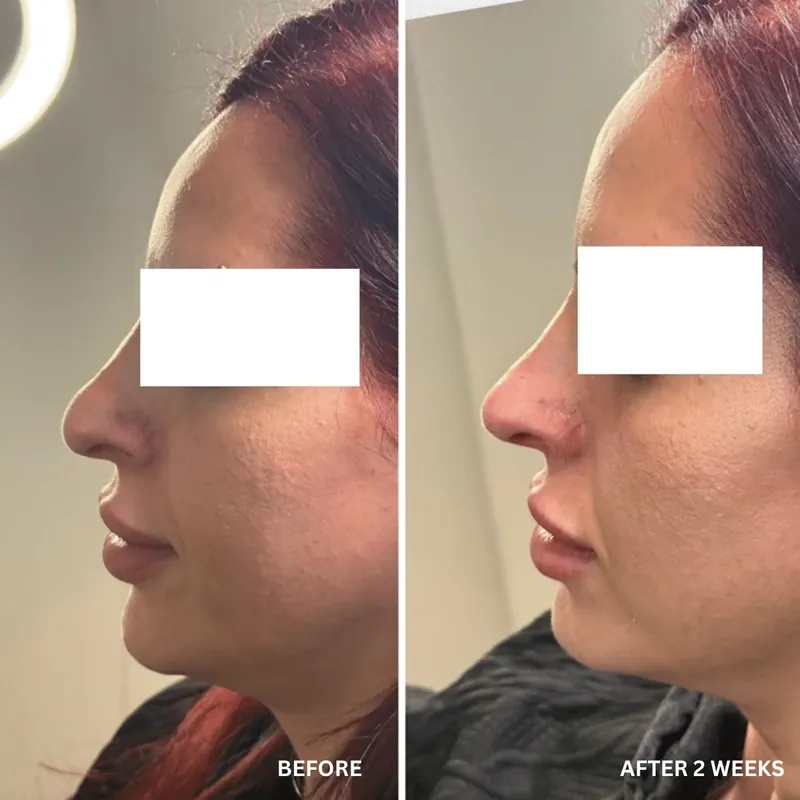
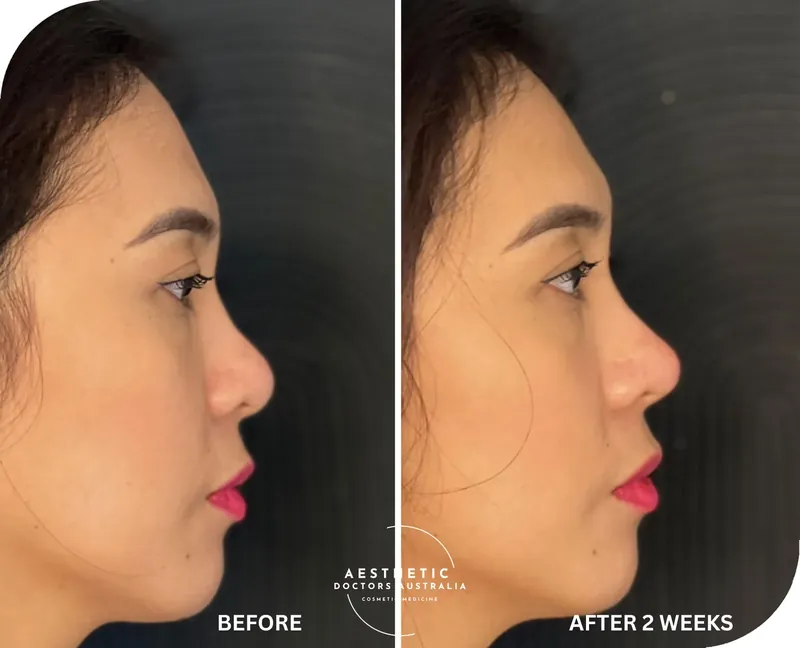
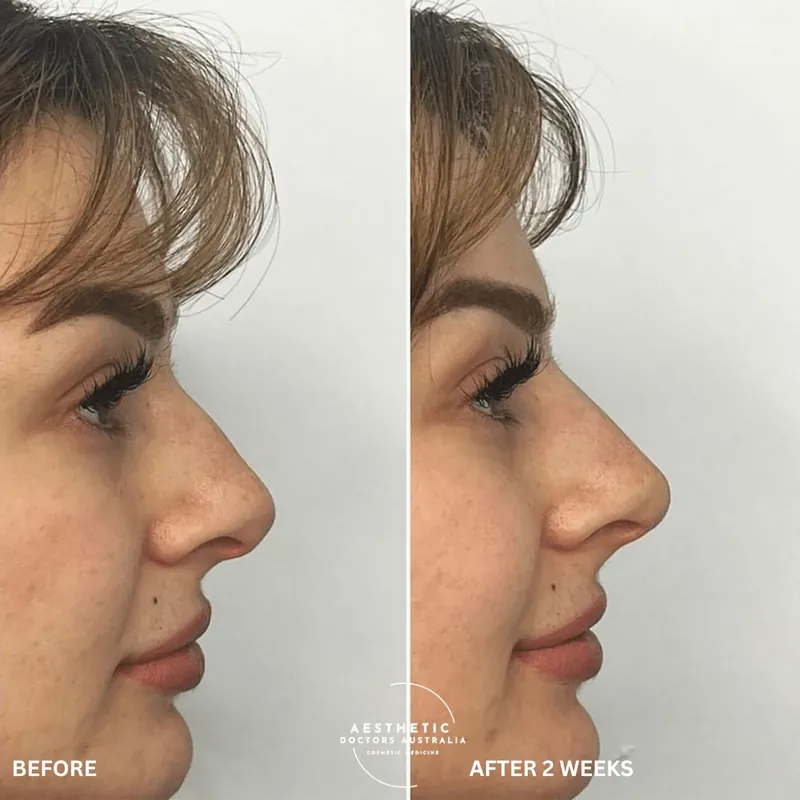
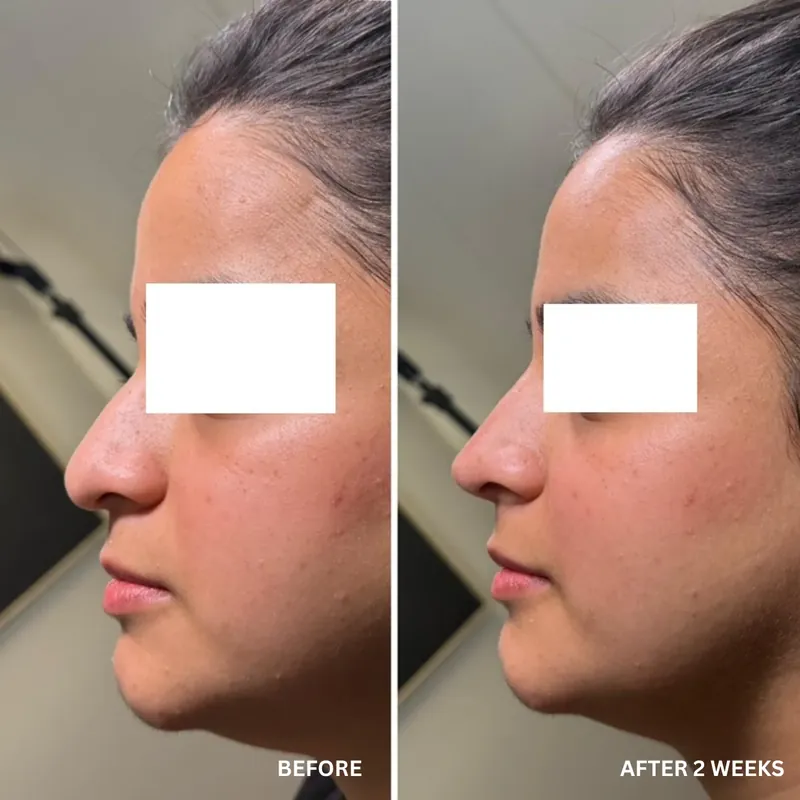
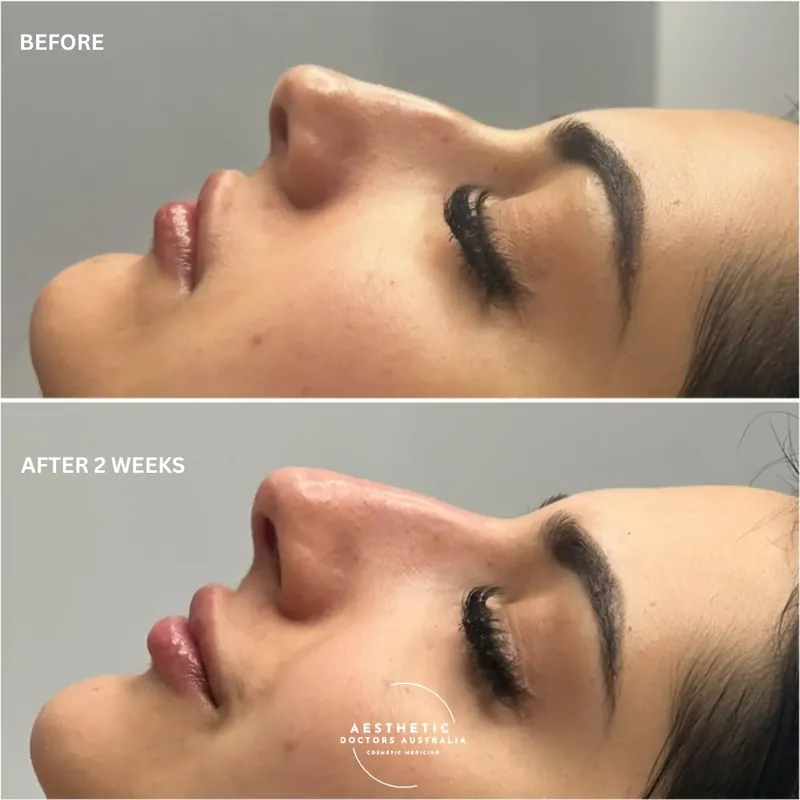
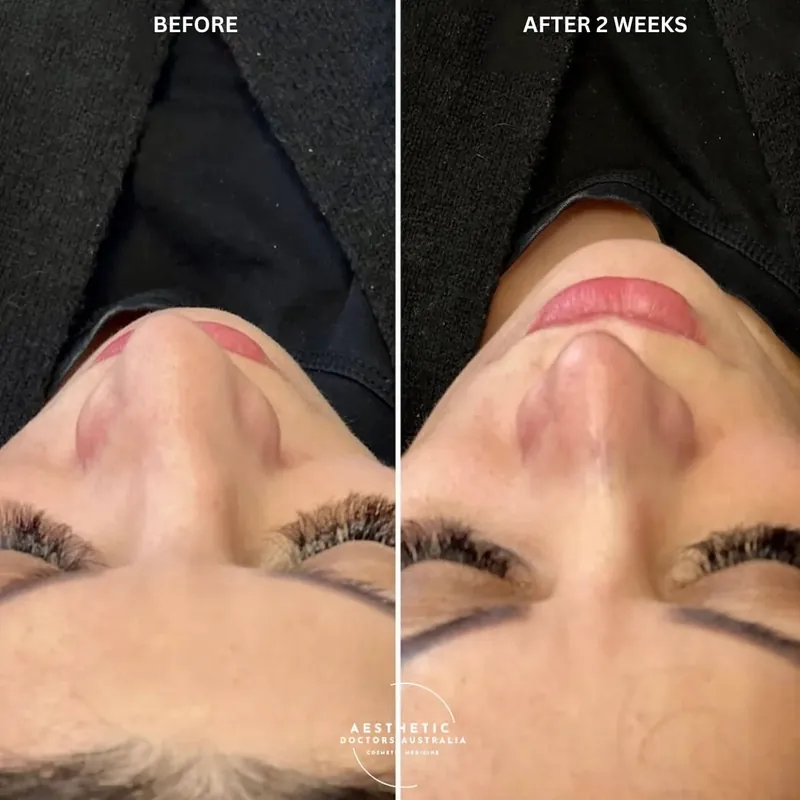
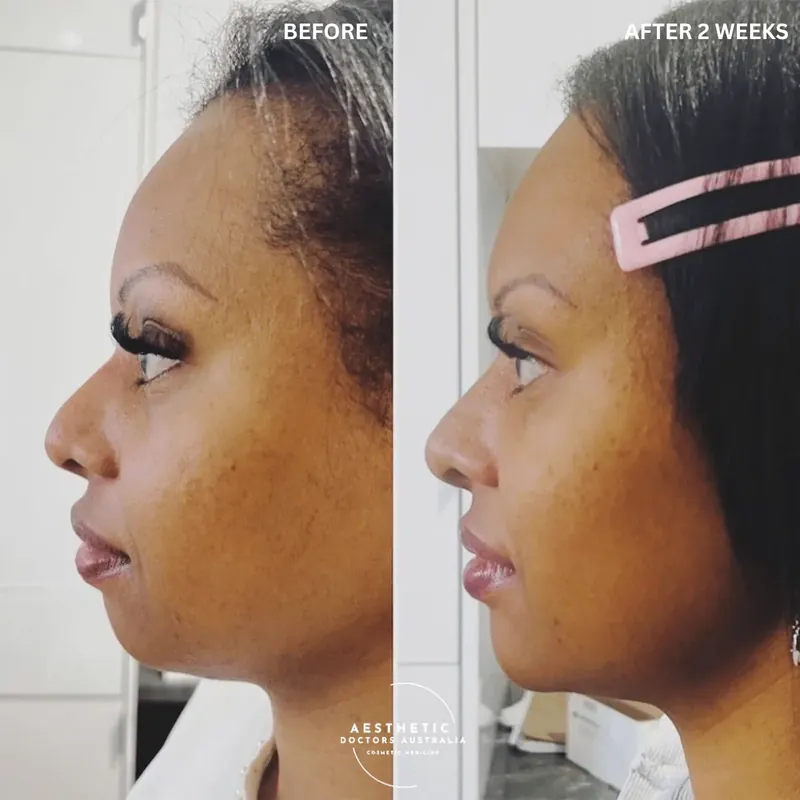
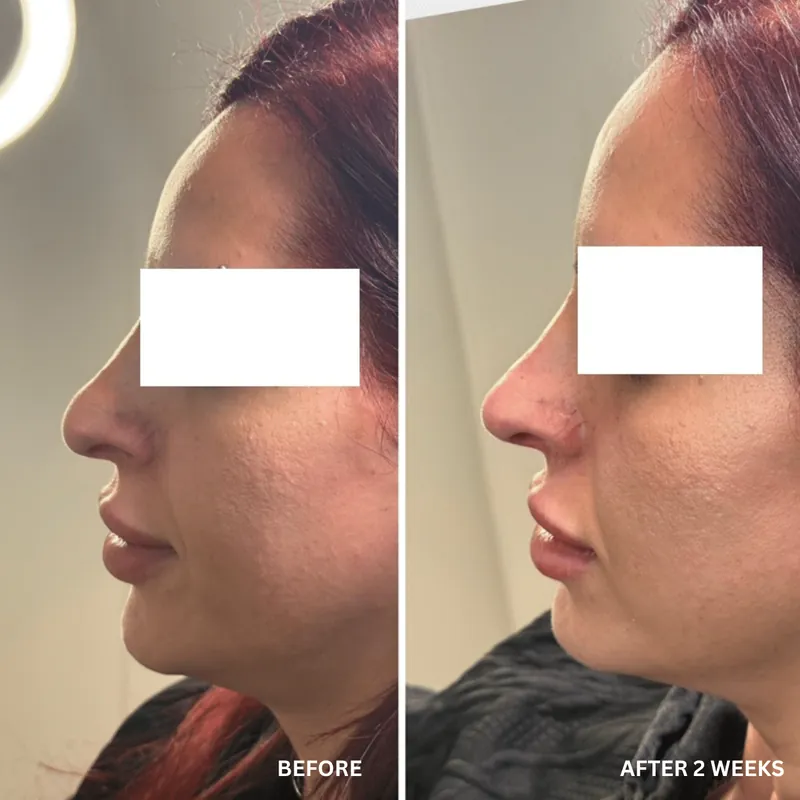
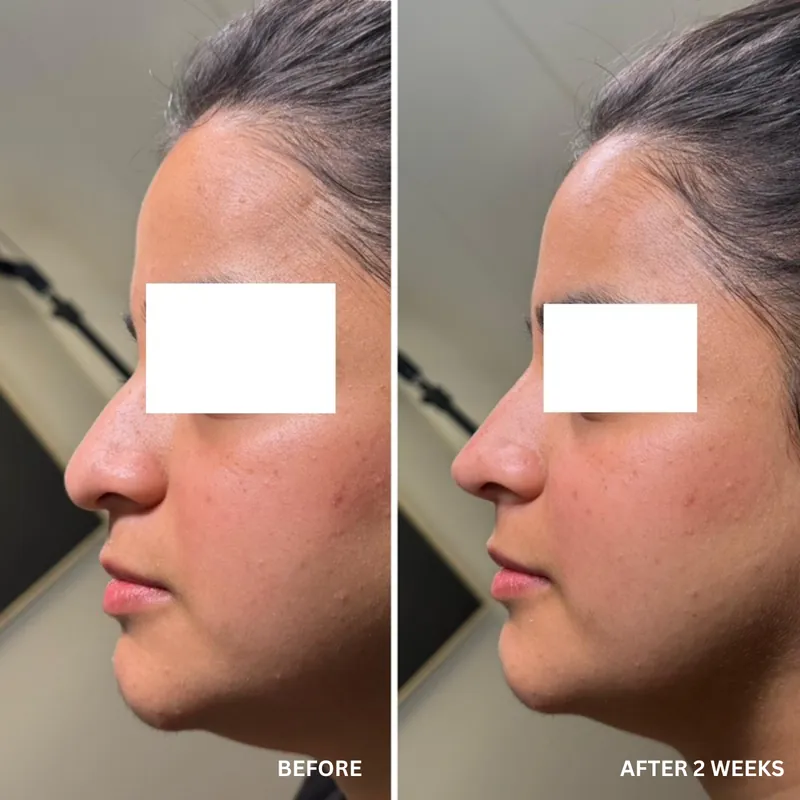
Non-surgical rhinoplasty: results from the clinic.
Each case is a single composite photographed at the practice: the concern that brought the patient in, the treatment performed, and the point at which the result was reviewed. Outcomes vary from person to person. This is clinical context, not a promise.
This result is specific to this patient and will not necessarily reflect another person's outcome.
A dorsal hump with a downturned tip in profile
Non-surgical rhinoplasty
This result is specific to this patient and will not necessarily reflect another person's outcome.
A droopy nasal tip viewed from below
PDO nose threads
This result is specific to this patient and will not necessarily reflect another person's outcome.
A dorsal hump breaking the profile line
Non-surgical rhinoplasty
This result is specific to this patient and will not necessarily reflect another person's outcome.
A drooping nasal tip in profile
Non-surgical rhinoplasty
This result is specific to this patient and will not necessarily reflect another person's outcome.
Unevenness along the bridge of the nose
Non-surgical rhinoplasty
This result is specific to this patient and will not necessarily reflect another person's outcome.
A dorsal bump with a downturned tip
Non-surgical rhinoplasty
This result is specific to this patient and will not necessarily reflect another person's outcome.
Irregular bridge contour seen reclined
Non-surgical rhinoplasty
This result is specific to this patient and will not necessarily reflect another person's outcome.
Nasal tip and nostril asymmetry viewed from below
Non-surgical rhinoplasty
This result is specific to this patient and will not necessarily reflect another person's outcome.
A low bridge with reduced tip definition
Non-surgical rhinoplasty
Images are real patients treated by Dr Rakib Uddin and are used with consent. Individual outcomes vary depending on anatomy, medical history, technique and aftercare; results shown are not a guarantee of yours.
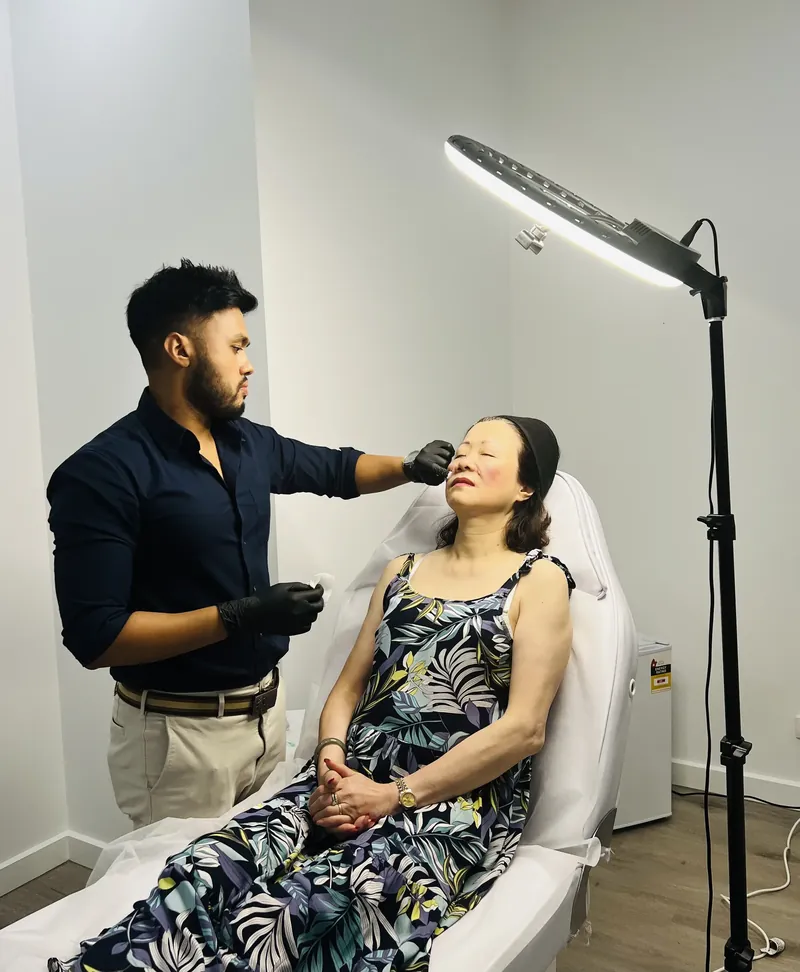
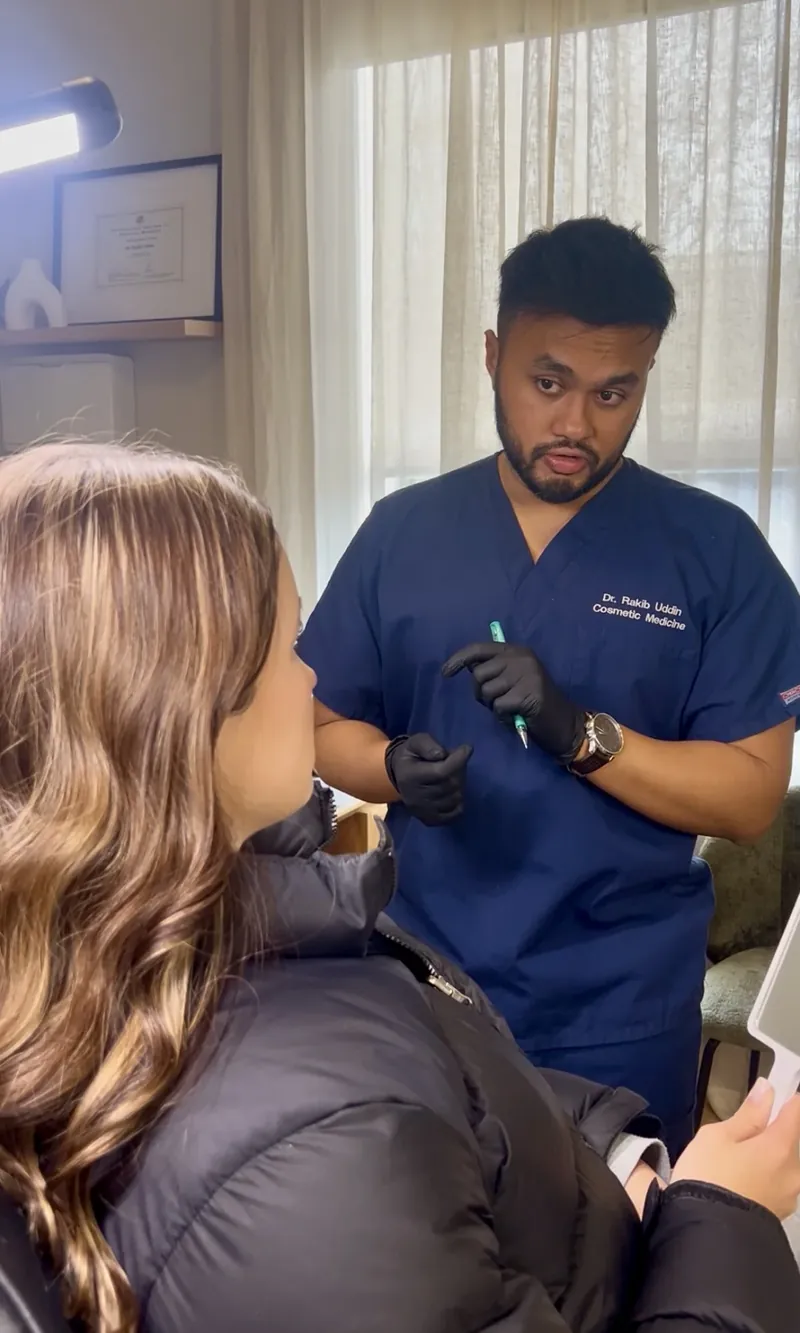
From the clinic
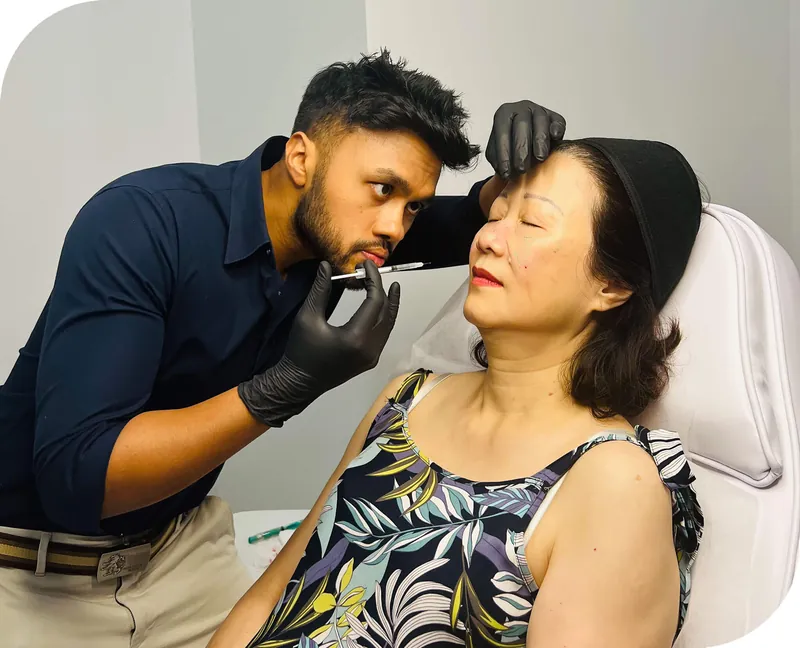
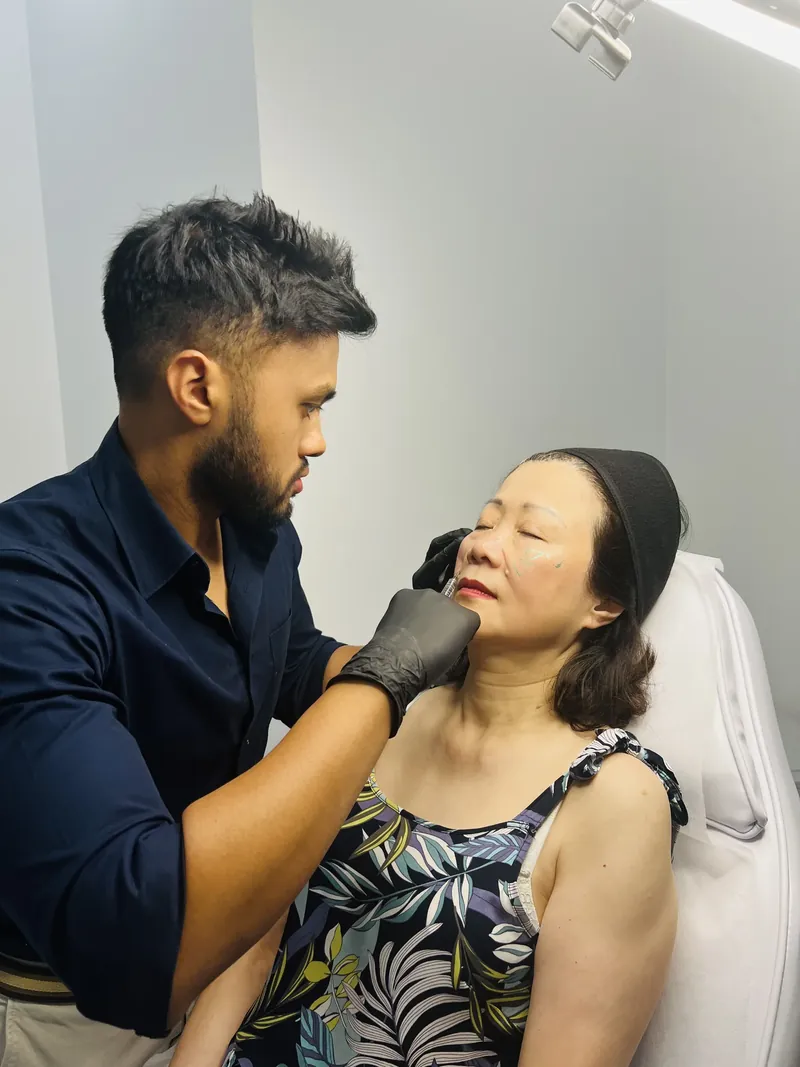
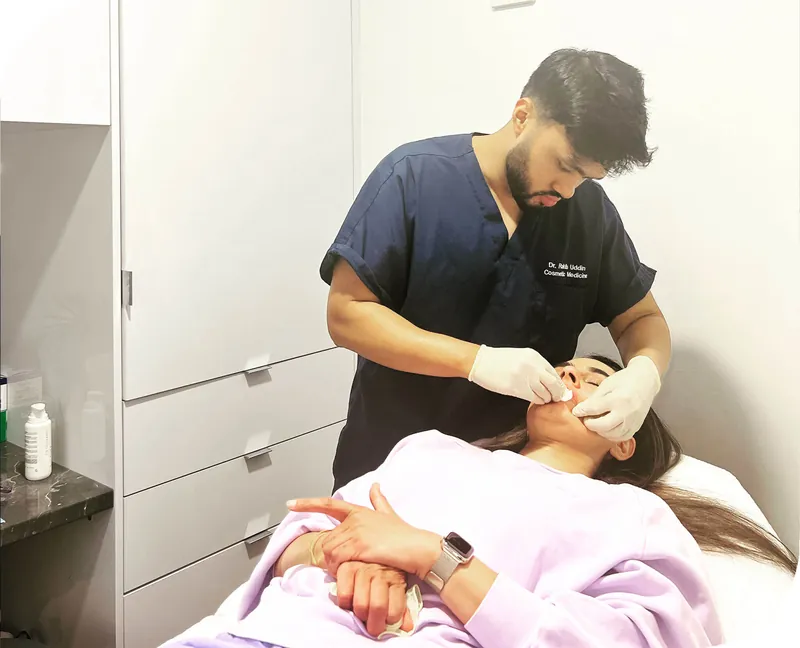
Non-surgical rhinoplasty, in practice.
Selected imagery from the clinic: the same material discussed at consultation.
2 images · tap to enlarge
Imagery reflects work performed at the clinic. Individual results vary: outcomes depend on anatomy, the agreed plan and aftercare. Shown for education, not as a guarantee of result.
How it works
How does non-surgical rhinoplasty work?
Step 01
01 / 03
Why illusion beats removal
A hump on the bridge isn't the actual problem: the problem is the bend in the profile line above and below it. Filling either side of the hump straightens the line, and the same volume that 'adds' to your nose makes it read smoother and frequently smaller. The illusion is real, and it's powerful.
Step 02
02 / 03
Tip support and rotation
A small volume placed at the columella (the strut between your nostrils) lifts the tip: a tip-rotation effect that opens the angle between nose and upper lip. This is the most-requested non-surgical change because it works in profile, three-quarter view and from below.
Step 03
03 / 03
Why this is doctor-only work
The vascular anatomy of the nose includes end-arteries that can cause skin necrosis or, in rare cases, blindness if filler is wrongly placed. Required knowledge: planes, vessel locations, danger zones, slow-bolus technique, and immediate access to dissolving agent. This is not a treatment to choose by price.
Where it's treated
Where on the face and body can non-surgical rhinoplasty be used?
Radix
Deep nasal-bridge starting point
Raises the upper bridge to balance a hump or low starting profile.
Dorsum
Bumps
Asymmetry
Smooths the line that profiles in photos.
Tip & columella
Droop
Under-projection
Lifts and projects the tip; opens the nose-lip angle.
Supratip
Pollybeak-style supratip fullness post-surgery
Camouflage of irregularities after a previous rhinoplasty.
Whether it suits you
Is non-surgical rhinoplasty right for you?
The two lists below are where that answer starts; it is confirmed in person, never assumed. Balanced information protects you.
May be suitable for
✓ Small to moderate dorsal humps
✓ Tip droop wanting subtle lift
✓ Asymmetry within reasonable bounds
✓ Post-surgical refinement of small irregularities
✓ Anyone wanting to 'try' a change before considering surgery
May not be suitable for
✕ Very large noses where size is the concern: filler adds, it doesn't reduce
✕ Significant functional breathing issues (refer to ENT)
Static profile from all angles plus animation while smiling
02
Identifying what specifically you want to change in your own words
03
Bone, cartilage and skin thickness: thin skin shows everything
04
An ultrasound scan of the nose before any injection, mapping your own vessel anatomy rather than working from the textbook average
05
Vascular anatomy review and treatment planning built on what that scan shows
06
Careful assessment of whether non-surgical can achieve enough, or whether surgical referral is the better recommendation
07
Discussion of reversibility and what 'changing your mind' looks like
What to expect
How long does non-surgical rhinoplasty take to work?
The short version: immediate, refining over 2 weeks, typically 12 to 18 months. Stage by stage:
Day 0
Treatment day
Numbing, careful slow placement. Immediate visible reshape, with a small amount of swelling beginning.
Days 1 to 7
Settling
Any bruising clears; the small amount of post-injection swelling resolves.
Weeks 2 to 4
Final shape
Filler integrated, final silhouette reviewed against pre-treatment photos.
12 to 18 months
Longevity
Even softening as the product slowly clears. Repeat treatment is generally less volume than the first.
Aesthetic medicine
In practice
“Reshape the silhouette without crossing the bridge to surgery.”
A consultation philosophy of restraint, anatomical precision and natural-looking outcomes: applied to non-surgical rhinoplasty planning.
Aesthetic Doctors Australia by Dr Rakib
On the day
What happens during a non-surgical rhinoplasty appointment?
01
Consultation
Your concern, history and goals: discussed before anything else.
02
Assessment
Anatomy, suitability and alternatives examined properly.
03
Planning
A personalised plan with costs, staging and realistic outcomes.
04
Procedure
Performed by Dr Rakib or a clinician working to his plan, with comfort prioritised.
05
Recovery
Clear aftercare and direct access to the clinic with questions.
06
Review
Results checked against plan; refinements made where needed.
Recovery
What is recovery like after non-surgical rhinoplasty?
Typical downtime: possible swelling and small bruise points for 24 to 72 hours. The specifics:
What's normal afterwards
Mild tenderness at injection points
Possible small bruise or two (rare with good technique)
Faint swelling settling within a few days
What to avoid
✕ Glasses pressing on the bridge for the first week
✕ Strenuous exercise and high heat for 48 hours
✕ Pressure or rubbing on the nose for 72 hours
✕ Alcohol on treatment day
Risks and limits
What are the risks of non-surgical rhinoplasty?
No effective treatment is risk-free, and no treatment does everything. Knowing both sides is part of informed consent.
Possible side effects
Tenderness, mild swelling and the occasional bruise: short-lived
Asymmetry while swelling settles, correctable at review
Rarely, vascular complications: the highest-risk filler region anatomically, which is why Dr Rakib ultrasound scans the nose before injecting, and why doctor-only technique and immediate dissolving access matter
Limitations to understand
Adds, doesn't reduce: a smaller nose requires surgery
Very large humps cannot be fully camouflaged without making the nose noticeably bigger
Skin thickness limits subtle work: thin skin shows even small volumes
Result is temporary by design
The alternatives
Non-surgical rhinoplasty compared with the alternatives
Non-surgical vs surgical rhinoplasty
Non-surgical (filler)
Reversible, minutes not weeks
Adds volume to camouflage shape
12 to 18 months duration
Surgical rhinoplasty
Permanent structural change
Can reduce size and remove tissue
Recovery measured in weeks
Which oneDifferent tools for different problems. Non-surgical excels at small refinements and 'try before you buy'. Surgical is the answer when size, breathing or significant change is the goal. We refer to surgical colleagues when that's the right recommendation.
Non-surgical rhinoplasty vs thread nose lift
Filler-based reshape
Reshapes profile and tip
Suits most anatomies
Immediate volume control
Thread-based lift
Lifts tip via tissue support
Adds no volume
Shorter duration
Which oneFiller is more versatile; threads are an option for very subtle tip lift in suitable patients. Anatomical assessment determines which is appropriate, for most patients filler is the right starting point.
What it costs
What does non-surgical rhinoplasty cost?
You receive an itemised written quote at consultation, before committing to anything. The consultation is $75 for 45 minutes with Dr Rakib Uddin, redeemed against your treatment if you go ahead.
Most non-surgical rhinoplasty uses less product than people expect: quoted exactly at consultation after the assessment.
01 Volume required (most non-surgical noses use small amounts)
02 Whether tip and bridge are both treated
03 Product selection
04 Maintenance schedule
You commit to nothing in advance: the $75 consultation fee comes off your treatment if you go ahead, and the quote is written before anything is booked. If the recommendation is not to treat, that advice is the whole appointment.
Afterpay and Zip are available for treatment fees at the clinic, subject to each provider's own approval and terms.
Your doctor
Dr Rakib Uddin
Cosmetic Doctor & Founder
MBBS (Qld)
BMedSci (Hons)
Dip. Surgical Anatomy
Fellow ACCSM
AHPRA MED0001936872
Whatever is recommended at your consultation is planned by Dr Rakib and performed by him or a clinician on his team: never by a non-medical injector.
Dr Rakib Uddin is a Melbourne-based cosmetic doctor with formal surgical-anatomy training and over a decade in medicine. He leads every consultation, treatment and review at Aesthetic Doctors Australia, working with a clinical team he has trained and trusts, and trains other doctors in advanced injectable technique at Derma Medical Academy.
“If a treatment isn't right for you, I'll tell you. Every plan is built around your anatomy, not a template, and the goal is always a refreshed version of you, not a new face.”
✓Listen to your concern in full
✓Comprehensive medical and aesthetic assessment
✓Step-by-step treatment plan: single session or staged
✓Full discussion of risks, limitations and alternatives
✓Decline to treat when a procedure would do more harm than good
The questions worth asking about non-surgical rhinoplasty.
The questions that come up in the room, answered the way Dr Rakib answers them.
Do you scan the nose before injecting it?+
Yes, every time. Dr Rakib performs an ultrasound scan of the nose before any filler is injected, so the vessels are mapped in your own anatomy rather than assumed from an average. The nose is the highest-risk area on the face for filler and vessel position varies from person to person, so seeing where yours actually run changes how the treatment is planned. It is a deliberate safety step and it is not something every injector does.
Can a non-surgical nose job make my nose look smaller?+
In silhouette, often yes: straightening a hump or lifting a drooping tip makes the nose photograph smaller, even though we've technically added volume. Front-on, the nose is the same size or fractionally larger. If your goal is genuine width or volume reduction, that's surgical.
Is it safer than surgery?+
It's less invasive but not 'safer' in the abstract. Surgery has more downtime; non-surgical has a small but real vascular risk that depends entirely on the practitioner's anatomical knowledge. Doctor-level training and immediate access to dissolving agent is your protection: never have a nose treatment from a non-medical practitioner.
What if I don't like the result?+
The filler can be fully dissolved in a separate appointment, usually returning the nose to baseline within 24 to 48 hours. This is the chief advantage over surgery, and the reason many patients use non-surgical as a 'trial' before deciding whether to proceed to surgical rhinoplasty.
Will my glasses still fit?+
For the first week we ask patients to avoid pressure on the bridge while the filler integrates. After that, glasses fit normally. If you wear glasses daily, we map the treatment to leave the nosepad zone untouched.
How long does it actually last?+
Twelve to eighteen months is typical, but the nose moves less than most facial regions which extends longevity: many patients still see meaningful result at two years. Repeat treatments tend to need less volume.
Why is it more expensive than I expected?+
Two reasons. First, the product is usually a premium long-lasting hyaluronic acid. Second, the medical risk profile demands a doctor's time, anatomical training and the safety equipment to manage any complication. Lower prices at this site or others almost always mean cutting one of these, and that's where it goes wrong.
All information on this page is general in nature and is not a substitute for a medical consultation.
Any before-and-after images shown are for illustrative purposes only and do not guarantee individual
outcomes. Treatments performed by Dr Rakib Uddin (AHPRA MED0001936872) vary based on each
patient's unique anatomy, medical history and needs. All cosmetic injectable treatments carry risks;
a consultation is required prior to any treatment to assess suitability, discuss risks and
alternatives, and establish realistic expectations.