Aesthetic Doctors Australia

Menu

Where would you like to begin?

Ultrasound-guided filler assessment in Kew, Melbourne

Filler-related complications, explained.

Lumps, migration, asymmetry, late swelling, or a result that never looked right: filler problems are common, usually fixable, and occasionally urgent. Dr Rakib's pathway for them is ultrasound assessment first, so the product is seen before it is treated, then dissolving where that is the answer.

Reviewed by Dr Rakib Uddin AHPRA MED0001936872

  • The cause identified before any treatment
  • Assessed by Dr Rakib and his team
  • Alternatives explained, including not treating
  • A clear pathway to the right option
Commissioned editorial study for this concern
Assessment with Dr Rakib

What's happening

Filler-related complications: what is actually happening?

Filler-related complications cover everything from the cosmetic to the medical: visible lumps and bumps, product that has migrated from where it was placed, asymmetry, puffiness from over-filling, a bluish tinge where product sits too superficially, delayed swelling that arrives months later, and, rarely but seriously, vascular compromise where filler obstructs a blood vessel. Some of these appear straight after treatment; others declare themselves years on.

The approach here is assessment before correction: ultrasound first, dissolving only where dissolving is the answer. Imaging shows where the product actually sits, which plane it is in and what it is near, before any decision is made. Hyaluronic acid filler can then be dissolved precisely where it is wrong, rather than blindly, and correction or re-treatment is planned only once the area has settled and been reassessed.

  • See before treating

    Ultrasound first

    Imaging shows where product actually sits, and what it is near.

  • Dissolvable

    HA reverses

    Hyaluronic acid filler can be dissolved; most others cannot.

  • For vascular signs

    Same-day rule

    Blanching, mottling or severe pain need review immediately.

The causes

Why does it happen?

Most cases come down to product placed too superficially or in the wrong plane, migration over time, over-volumisation, delayed inflammatory reactions, and rarely vascular compromise. More than one is usually contributing at once, which is why the cause gets named before any treatment is suggested.

  1. Placement and plane

    Product placed too superficially, or in a plane that moves, shows as lumps, ridges or a visible tint. Where filler sits matters as much as how much was used.

  2. Migration over time

    Filler can drift from its placement, most familiarly above the lip border, where repeated treatment or volume beyond what the tissue holds lets product travel.

  3. Over-volumisation

    Cumulative treatment without an overall plan leaves faces carrying more product than their anatomy can wear. The result reads as puffiness rather than structure.

  4. Delayed inflammatory reactions

    Months or years after uneventful treatment, an immune response, sometimes triggered by illness or a procedure, can swell old filler. Uncommon, unsettling, and usually manageable once diagnosed.

  5. Vascular compromise

    The rare emergency: filler obstructing a vessel, showing as blanching, mottled or dusky skin, or pain out of proportion. It needs urgent dissolving, which is why access to an experienced doctor matters.

The types

What are the different types?

There are 4 patterns worth telling apart, and the right plan depends on which one is yours.

  1. Lumps and surface irregularity

    Palpable or visible product, often superficial; frequently dissolvable with precision.

    Dissolving & ultrasound
  2. Migration

    Product outside its intended zone, the lip border the classic example.

    Dissolving & ultrasound
  3. Over-filled appearance

    The cumulative look of too much product; assessed as a whole, dissolved strategically.

    Dissolving & ultrasound
  4. Delayed swelling or nodules

    Late reactions around older product; imaged, diagnosed and managed medically.

    Ultrasound assessment

Which one is yours

Which one are you seeing?

Match what you notice in the mirror to a likely cause and the pathway worth discussing. It is a starting point, not a diagnosis: the assessment confirms it.

  1. If you notice

    “I can feel or see a lump where I had filler”

    Possible cause

    Superficial or displaced product

    Pathway

    Ultrasound to locate it precisely, then targeted dissolving if confirmed

    Dissolving & ultrasound
  2. If you notice

    “My lip filler has crept above my lip line”

    Possible cause

    Migration

    Pathway

    Dissolve the migrated product, let the area settle, replan properly

    Dissolving & ultrasound
  3. If you notice

    “My face looks puffy and I have had filler at several clinics over the years”

    Possible cause

    Cumulative over-volumisation

    Pathway

    Whole-face ultrasound mapping, then staged strategic dissolving

    Ultrasound assessment
  4. If you notice

    “Skin near a recent injection has gone pale, mottled or intensely painful”

    Possible cause

    Possible vascular compromise

    Pathway

    This is urgent: contact the treating clinic or seek medical review the same day

    Contact the clinic

What treats it

Which treatment actually addresses it?

The one that matches your cause. Each pathway below pairs a driver with the plan Dr Rakib Uddin would discuss for it: same concern, different cause, different treatment.

  1. When the problem needs to be seen before it is treated

    The first step with any filler problem is assessment, not correction. Ultrasound shows the product's depth, spread and relationship to vessels, distinguishes filler from swelling or scar, and turns dissolving from a guess into a targeted procedure.

  2. When hyaluronic acid product is in the wrong place

    Hyaluronidase dissolves HA filler where it is misplaced, migrated or excessive. Most resolution happens within 24–72 hours, with a two-week review before any decision about re-treatment. Only what is wrong needs dissolving; a good result elsewhere can stay.

  3. When the area needs rebuilding after correction

    Once dissolved and settled, re-treatment starts from a clean, mapped baseline. Rebuilding is staged and conservative, which is how the original problem is avoided the second time around.

  4. When the signs suggest a vascular problem

    Blanching, dusky or mottled skin, or severe pain after filler are treated as an emergency: immediate assessment and urgent dissolving protect the tissue the vessel supplies. If your treating clinic is unreachable, seek urgent medical care rather than waiting.

Where to go next

The treatment guides worth reading.

Each guide explains how the treatment works, who it suits, recovery and cost. The right one for your case is confirmed at assessment, not assumed online.

Prevention

What slows it down?

The habits below protect the result of any treatment, and slow the concern when it is still early. None of them replace assessment; all of them help.

  • Choose the injector, not the deal

    Most complications trace back to placement, product choice or volume decisions. A medical practitioner who assesses first, uses restraint and can manage their own complications is the best prevention available.

  • Keep a treatment record

    Know what product went where, and when, across every clinic you have visited. It makes any future assessment faster and any complication easier to diagnose.

  • Resist the top-up habit

    Regular top-ups without reassessment are how over-volumisation happens by instalments. Less product, reviewed properly, ages far better than little-and-often forever.

  • Take late changes seriously

    New swelling or firmness around old filler months later is not something to watch indefinitely. It is usually manageable, and much more easily when imaged and diagnosed early.

Common beliefs

What do people get wrong about it?

The beliefs patients most often arrive with, next to what is actually true.

  • Commonly believed

    “Filler dissolves completely on its own within a year”

    In practice

    HA filler often persists far longer than its quoted lifespan, and imaging regularly finds product years after placement. Problems do not always time-out on their own; unwanted filler can simply stay until dissolved.

  • Commonly believed

    “Dissolving ruins your natural tissue”

    In practice

    Hyaluronidase breaks down hyaluronic acid filler and is used routinely and safely by experienced doctors. The area can look deflated until it settles over a fortnight; the tissue itself returns to its own baseline.

  • Commonly believed

    “A complication means the whole face must be dissolved”

    In practice

    Dissolving is targeted, and ultrasound is what makes it so: product causing the problem is treated, well-placed product elsewhere can stay. Whole-face reset is occasionally right; it is never the default.

In consultation

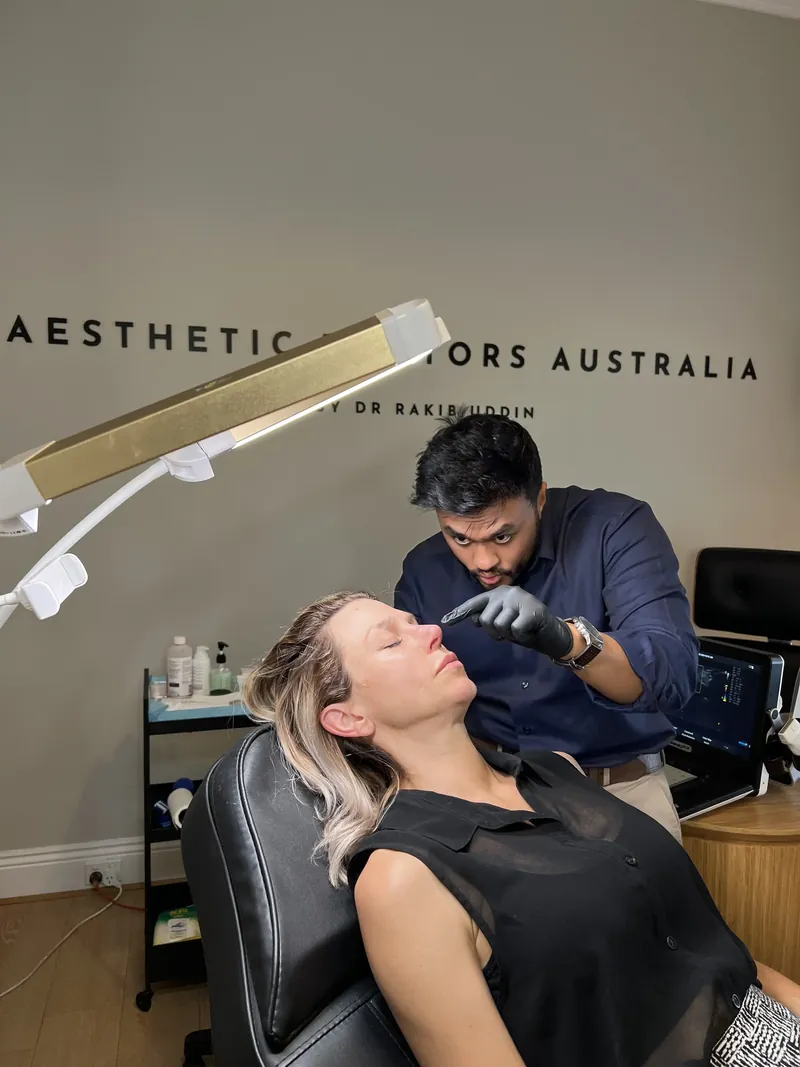
You cannot treat what you cannot see: the ultrasound comes before the syringe.

Cause before treatment: how Dr Rakib Uddin approaches filler complications.

Dr Rakib Uddin, cosmetic doctor and founder of Aesthetic Doctors Australia

Your doctor

Dr Rakib Uddin

Cosmetic Doctor & Founder

  • MBBS (Qld)
  • BMedSci (Hons)
  • Dip. Surgical Anatomy
  • Fellow ACCSM

AHPRA MED0001936872

Every consultation for filler complications is performed by Dr Rakib and his team: never delegated to a non-medical injector.

Dr Rakib Uddin is a Melbourne-based cosmetic doctor with formal surgical-anatomy training and over a decade in medicine. He performs every consultation, treatment and review at Aesthetic Doctors Australia personally, and trains other doctors in advanced injectable technique at Derma Medical Academy.

“If a treatment isn't right for you, I'll tell you. Every plan is built around your anatomy, not a template, and the goal is always a refreshed version of you, not a new face.”
  • Listen to your concern in full
  • Comprehensive medical and aesthetic assessment
  • Step-by-step treatment plan: single session or staged
  • Full discussion of risks, limitations and alternatives
  • Decline to treat when a procedure would do more harm than good
About the practice

Expert questions

The questions worth asking about filler complications.

The questions that come up in the room, answered the way Dr Rakib answers them.

Why does the ultrasound matter so much?

Because without it, dissolving is done blind: filler cannot be reliably located by feel, and swelling, scar and product can be indistinguishable from the surface. Imaging shows depth, spread and nearby vessels, so the hyaluronidase goes precisely where the problem is. It is the difference between a targeted correction and a blind one.

Can you fix filler that was done at another clinic?

Yes: assessment does not require the original treatment to have happened here, and reviewing previous work from elsewhere is a routine part of this clinic's caseload. Bring whatever record you have of what was used and when; ultrasound fills in the rest of the picture.

Which fillers can and cannot be dissolved?

Hyaluronic acid fillers, the most widely used class, dissolve with hyaluronidase. Collagen biostimulators and other non-HA products cannot be dissolved; they are managed differently, which the ultrasound-informed assessment covers. If you are unsure what you had, that is exactly what imaging helps establish.

What are the warning signs that cannot wait?

Skin turning white, dusky or net-like mottled near an injection site, pain far beyond normal tenderness, or any change in vision after facial filler. These suggest a vessel problem: contact the treating clinic immediately, and if unreachable, seek urgent medical care the same day. Everything else, lumps and migration included, can be booked normally.

How soon after dissolving can the area be re-treated?

Reassessment happens at about two weeks, once swelling has settled and the true baseline shows. Re-treatment, where still wanted, is planned from that reset: staged, conservative and mapped, so the correction is not followed by a repeat of the original problem.

Consultation first

Understand the cause. Then choose the pathway.

A consultation with Dr Rakib Uddin works out what's driving filler complications in your case, then matches the right treatment, an alternative, or no treatment at all.

1167 Burke Road, Kew VIC 3101

Important treatment information

All information on this page is general in nature and is not a substitute for a medical consultation. Any before-and-after images shown are for illustrative purposes only and do not guarantee individual outcomes. Treatments performed by Dr Rakib Uddin (AHPRA MED0001936872) vary based on each patient's unique anatomy, medical history and needs. All cosmetic injectable treatments carry risks; a consultation is required prior to any treatment to assess suitability, discuss risks and alternatives, and establish realistic expectations.

Consultation Filler complications
Book