Aesthetic Doctors Australia

Menu

Where would you like to begin?

Regenerative hair-loss treatment in Kew, Melbourne

PRF Hair Treatment Melbourne

A doctor-performed, drug-free approach to thinning hair: your own platelet-rich fibrin returned to the scalp to support follicles while they can still respond.

Reviewed by Dr Rakib Uddin AHPRA MED0001936872

  • Performed by Dr Rakib and his team
  • Personalised assessment first
  • Clear advice, including when not to treat
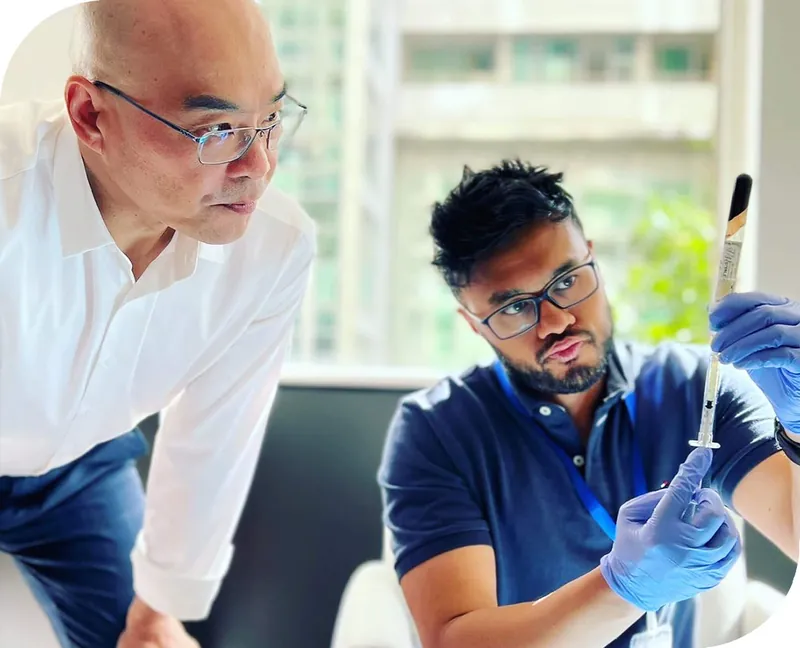
PRF hair treatment for thinning hair at Aesthetic Doctors Australia by Dr Rakib in Melbourne
Performed by Dr Rakib

What it is

What is PRF hair treatment?

PRF (platelet-rich fibrin) hair treatment concentrates the regenerative components of your own blood (platelets, white cells and fibrin) and returns them to areas of thinning scalp via micro-injections. There is no drug and no donor material: the active ingredient is biology you arrived with.

PRF is the second-generation evolution of PRP. Spun more slowly and without anticoagulant, it forms a natural fibrin matrix that releases growth factors over days rather than minutes: a sustained signal that suits the slow rhythm of hair-follicle biology. This is why our clinic moved from PRP to PRF protocols.

  • Programme

    3–4 sessions

    Monthly, building cumulative follicle support.

  • Visible regrowth

    Months 3–6

    Follicle cycles run in weeks, not days: biology takes time.

  • Autologous

    Drug-free

    The active ingredient is biology you arrived with.

What it treats

What does PRF hair treatment treat?

PRF hair treatment is most often planned for early-to-moderate thinning, reduced density, shedding support. The treatment only makes sense when it matches the cause of your concern; here is where it fits.

  • Hair thinning & loss

    Explore this concern

    Why it happens

    In pattern thinning, follicles progressively miniaturise: each growth cycle produces a finer, shorter hair until the follicle finally goes dormant. Stress, hormonal shifts and nutrition can accelerate the process.

    Treatment role

    Growth factors delivered to the follicle environment support blood supply and can push miniaturising follicles back toward thicker, longer growth phases: most effective while follicles are weakened rather than gone.

How it works

How does PRF hair treatment work?

Hair thinning anatomy reference for PRF treatment planning at Aesthetic Doctors Australia Step 01

01 / 03

Follicle miniaturisation

Thinning hair is usually shrinking hair: the follicle remains alive but produces progressively finer strands with shorter growth phases. Dormant follicles can persist for years before disappearing: a closing window during which intervention can still change the trajectory.

PRF preparation and centrifuge step at Aesthetic Doctors Australia Step 02

02 / 03

Why PRF over PRP

Slower centrifugation without anticoagulant preserves a fibrin scaffold and a higher concentration of regenerative cells. The fibrin matrix traps platelets and releases their growth factors over roughly a week, where PRP's release completes within hours. For follicles, sustained signalling beats a spike.

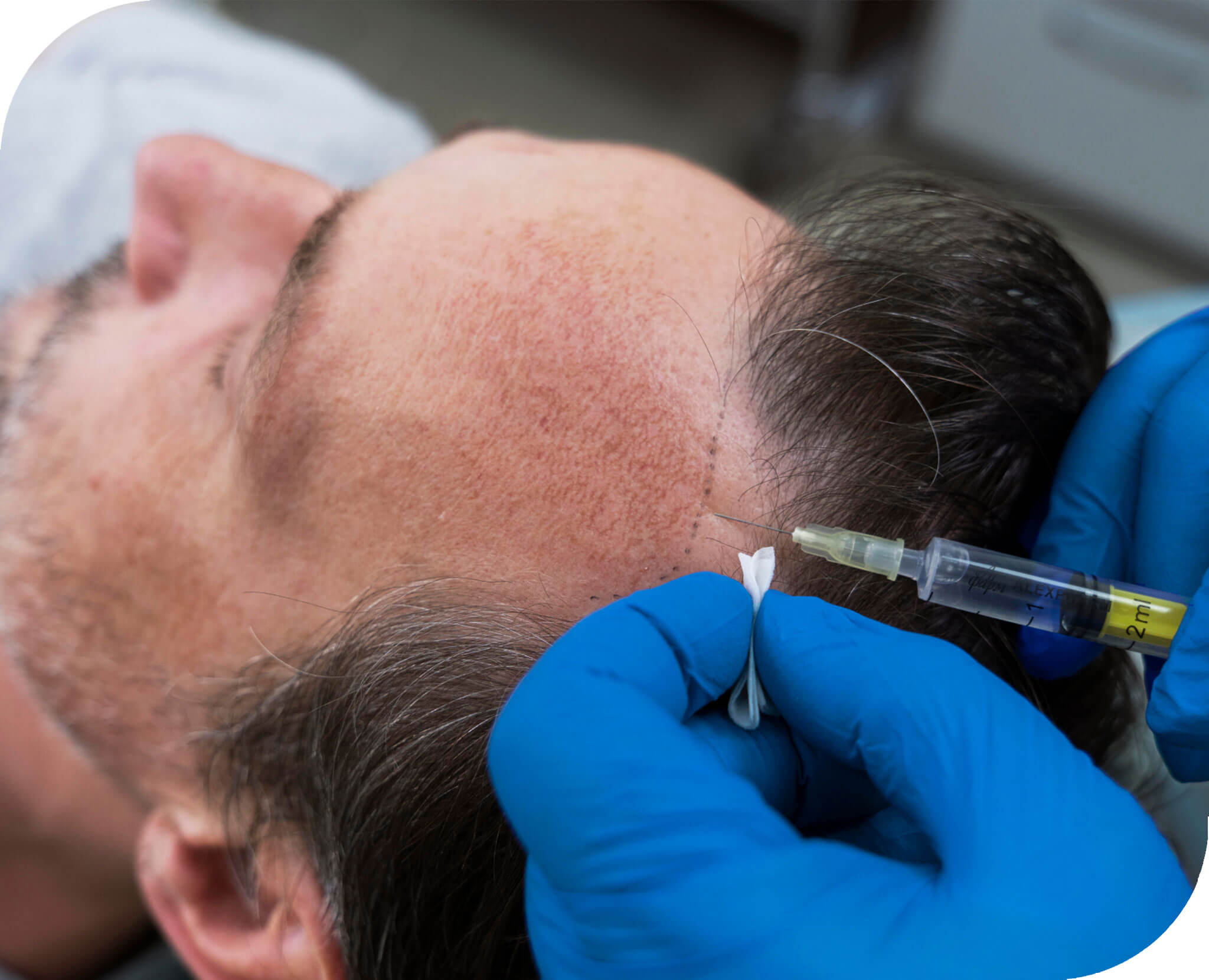
Scalp PRF injection placement detail by Dr Rakib in Melbourne Step 03

03 / 03

What the growth factors do

Platelet-derived factors (PDGF, VEGF, EGF among others) promote micro-vessel formation around follicles, stimulate the dermal papilla cells that govern hair-cycle timing, and extend the anagen (growth) phase: collectively shifting follicles from decline toward maintenance and recovery.

Whether it suits you

Is PRF hair treatment right for you?

The two lists below are where that answer starts; it is confirmed in person, never assumed. Balanced information protects you.

May be suitable for

  • Early-to-moderate pattern thinning in men and women
  • Diffuse thinning or post-shedding density loss
  • Patients preferring a drug-free, autologous approach
  • Supporting and maintaining hair-transplant results

May not be suitable for

  • Completely bald areas: dormant follicles must still exist
  • Scarring alopecias and active autoimmune scalp disease
  • Platelet or clotting disorders; certain blood-thinning medications
  • Active scalp infection

The assessment

What happens at a PRF hair treatment consultation?

Expertise shows in process. Before any recommendation, your consultation examines:

Book your assessment
  1. 01

    Pattern and stage of thinning: mapped and photographed for objective comparison

  2. 02

    Scalp health and follicle status: thinning follicles respond; absent ones cannot

  3. 03

    Medical drivers worth excluding: thyroid, iron, hormonal factors

  4. 04

    Medications and supplements affecting hair or platelet function

  5. 05

    Realistic goal-setting: density recovery and stabilisation, not resurrection of bare scalp

  6. 06

    Whether adjunct approaches should run alongside the programme

What to expect

How long does PRF hair treatment take to work?

The short version: programme of 3–4 monthly sessions; assessed from month 3–4. Stage by stage:

  1. Monthly ×3–4

    Each session

    Blood draw, centrifuge, micro-injection across mapped zones. Tender scalp for a day or two.

  2. Weeks 4–8

    Shedding stabilises

    Often the first objective change: fewer hairs on the pillow and in the drain.

  3. Months 3–4

    Early regrowth

    Fine new growth at the part line and temples; existing hair begins cycling thicker.

  4. Months 6+

    Visible density

    Cumulative thickening becomes visible in photographs and styling. Formal comparison against baseline.

  5. Every 4–6 months

    Maintenance

    Single sessions hold the gain; hair biology needs ongoing support like any chronic process.

Aesthetic medicine

In practice
Support the follicles still cycling. They are the window that closes.

A consultation philosophy of restraint, anatomical precision and natural-looking outcomes: applied to PRF hair treatment planning.

Aesthetic Doctors Australia
by Dr Rakib

On the day

What happens during a PRF hair treatment appointment?

  1. 01

    Consultation

    Your concern, history and goals: discussed before anything else.

  2. 02

    Assessment

    Anatomy, suitability and alternatives examined properly.

  3. 03

    Planning

    A personalised plan with costs, staging and realistic outcomes.

  4. 04

    Procedure

    Performed by Dr Rakib or a clinician working to his plan, with comfort prioritised.

  5. 05

    Recovery

    Clear aftercare and direct access to the clinic with questions.

  6. 06

    Review

    Results checked against plan; refinements made where needed.

Recovery

What is recovery like after PRF hair treatment?

Typical downtime: scalp tenderness up to 48 hours; hair washing from next day. The specifics:

What's normal afterwards

  • Scalp tenderness and tight sensation for 24–48 hours
  • Possible pinpoint bleeding marks on the day
  • Occasional mild headache the first evening

What to avoid

  • Washing hair for 24 hours (then gentle products for a few days)
  • Strenuous exercise and sweating for 24 hours
  • Hair colouring or chemical treatments for one week
  • Anti-inflammatory medication where possible for 48 hours. It can blunt the intended response

Risks and limits

What are the risks of PRF hair treatment?

No effective treatment is risk-free, and no treatment does everything. Knowing both sides is part of informed consent.

Possible side effects

  • Tenderness, tightness and pinpoint marks: expected and short-lived
  • Mild swelling at the hairline occasionally
  • Because the material is your own blood, allergic and rejection risks are essentially eliminated

Limitations to understand

  • Cannot regrow hair where follicles have fully disappeared
  • Response varies with thinning stage: earlier is measurably better
  • A programme plus maintenance is required; single sessions rarely show meaningful change
  • Underlying medical drivers must be managed alongside or results plateau

The alternatives

PRF hair treatment compared with the alternatives

PRF vs PRP for hair

PRF (what we use)

  • No anticoagulant; slow spin
  • Fibrin matrix releases growth factors over ~a week
  • Higher regenerative cell content

PRP (previous generation)

  • Anticoagulant required; fast spin
  • Growth-factor release within hours
  • Plasma-only concentrate

Which one Both deliver platelet growth factors; the difference is the release curve. Follicle biology runs in weeks-long cycles, so the sustained PRF signal aligns better: the reason this clinic retired its PRP protocol in favour of PRF.

PRF vs medical (drug) therapy

PRF programme

  • Autologous, drug-free
  • In-clinic sessions, no daily routine
  • Supports follicle environment biologically

Prescription therapy

  • Daily ongoing medication
  • Acts on hormonal pathway or blood flow
  • Requires medical review and continuation

Which one These aren't rivals. They address different parts of the problem and combine well. A doctor consultation (rather than a clinic salesperson) can map which combination suits your pattern, stage and preferences.

What it costs

What does PRF hair treatment cost?

You receive an itemised written quote at consultation, before committing to anything. The consultation is $75 for 45 minutes with Dr Rakib Uddin, redeemed against your treatment if you go ahead.

Programmes are quoted in full at consultation. Be wary of single-session pricing anywhere: hair biology doesn't respond meaningfully to one-off treatment.

What determines your quote

  • 01 Programme length (three or four initial sessions)
  • 02 Treatment area size
  • 03 Maintenance schedule after the initial programme

You commit to nothing in advance: the consultation costs nothing and the quote is written before anything is booked. If the recommendation is not to treat, that advice is the whole appointment.

Afterpay acceptedZip accepted

Afterpay and Zip are available for treatment fees at the clinic, subject to each provider's own approval and terms.

Dr Rakib Uddin, cosmetic doctor and founder of Aesthetic Doctors Australia

Your doctor

Dr Rakib Uddin

Cosmetic Doctor & Founder

  • MBBS (Qld)
  • BMedSci (Hons)
  • Dip. Surgical Anatomy
  • Fellow ACCSM

AHPRA MED0001936872

Whatever is recommended at your consultation is planned by Dr Rakib and performed by him or a clinician on his team: never by a non-medical injector.

Dr Rakib Uddin is a Melbourne-based cosmetic doctor with formal surgical-anatomy training and over a decade in medicine. He performs every consultation, treatment and review at Aesthetic Doctors Australia personally, and trains other doctors in advanced injectable technique at Derma Medical Academy.

“If a treatment isn't right for you, I'll tell you. Every plan is built around your anatomy, not a template, and the goal is always a refreshed version of you, not a new face.”
  • Listen to your concern in full
  • Comprehensive medical and aesthetic assessment
  • Step-by-step treatment plan: single session or staged
  • Full discussion of risks, limitations and alternatives
  • Decline to treat when a procedure would do more harm than good
About the practice

Expert questions

The questions worth asking about PRF hair treatment.

The questions that come up in the room, answered the way Dr Rakib answers them.

How do I know if my follicles can still respond?

Visible fine, wispy hairs in the thinning zone are the tell: miniaturised follicles still cycling. Shine and completely smooth scalp suggest follicles are gone, and this matters: we examine your scalp under magnification at consultation and tell you which zones are worth treating and which aren't.

Why did the clinic replace PRP with PRF?

Evidence and design logic. PRF's fibrin matrix releases growth factors across about a week instead of hours, contains more regenerative cells, and skips the anticoagulant. Comparative studies in skin and hair applications consistently favour the sustained-release profile, so we updated the protocol.

When will I actually see new hair?

Set your expectations by hair biology: follicles cycle slowly. Reduced shedding often shows within four to eight weeks; fine regrowth from month three; photographic density change around month six. Anyone promising visible regrowth in weeks is selling, not treating.

Does it hurt?

The scalp is sensitive but the injections are shallow and quick. Most patients rate it uncomfortable rather than painful: pressure and stinging during the passes, a tender scalp for a day or two after. Numbing options exist for sensitive patients.

Is this suitable for women's thinning?

Yes, often particularly well-suited, because female-pattern thinning is typically diffuse miniaturisation with preserved follicles, exactly the biology PRF supports. We also screen for the medical drivers (iron, thyroid, hormonal shifts) that disproportionately affect women's hair before attributing everything to pattern loss.

What happens if I stop after the initial programme?

Gains hold for a while, then the underlying process resumes: pattern hair loss is chronic. Maintenance sessions every four to six months protect the investment. We'd rather you know that before starting than discover it a year later.

Consultation first

Book a personalised consultation.

Discuss PRF hair treatment with Dr Rakib Uddin: your anatomy, suitability, alternatives and realistic outcomes, before any decision is made.

1167 Burke Road, Kew VIC 3101

Important treatment information

All information on this page is general in nature and is not a substitute for a medical consultation. Any before-and-after images shown are for illustrative purposes only and do not guarantee individual outcomes. Treatments performed by Dr Rakib Uddin (AHPRA MED0001936872) vary based on each patient's unique anatomy, medical history and needs. All cosmetic injectable treatments carry risks; a consultation is required prior to any treatment to assess suitability, discuss risks and alternatives, and establish realistic expectations.

Consultation PRF hair treatment
Book