Thanks to celebrities like Kim Kardashian and Gwyneth Paltrow, you've probably heard about "vampire facials." During these treatments, your blood is used to rejuvenate your skin. This "facial" is actually called a PRP (platelet-rich plasma) treatment, and a similar procedure is PRF (platelet-rich fibrin), which also uses your body's blood platelets to address various cosmetic issues. These include enhancing skin texture, improving age-related loss of volume under the eyes, and improving hair health.
Although they're quite similar, PRP and PRF treatments have some important differences to know about. It can be confusing to know which blood-based treatment to choose, but don't worry. Continue reading our PRP vs. PRF treatment guide, and we'll provide you with clear information to help you make the best choice.
Similarities Between PRP and PRF:
- They use the patient's blood, reducing the risk of allergies.
- They're rich in platelets for skin rejuvenation.
- They're low-risk treatments with mild side effects.
- They're minimally invasive.
PRP for Hair and Skin Rejuvenation
PRP involves drawing a small amount of your blood and placing it in a centrifuge machine where it is spun at a high speed to concentrate the blood platelets. Then, the platelet-rich plasma containing beneficial growth factors is placed in a syringe and injected into areas of your skin or scalp. These growth factors are released within a few hours.
PRP treatments can be used to boost the skin's collagen and enhance tissue repair, while PRP hair treatments involve injecting your blood plasma into areas of the scalp where hair is thinning to encourage its healthy growth.
PRF Treatment: How it Differs From PRP
PRF is a more advanced blood-based facial treatment as compared to PRP. Think of it as PRP 2.0! Here's how it varies from PRP as a skin rejuvenation treatment.
It has a lower-speed centrifugation process
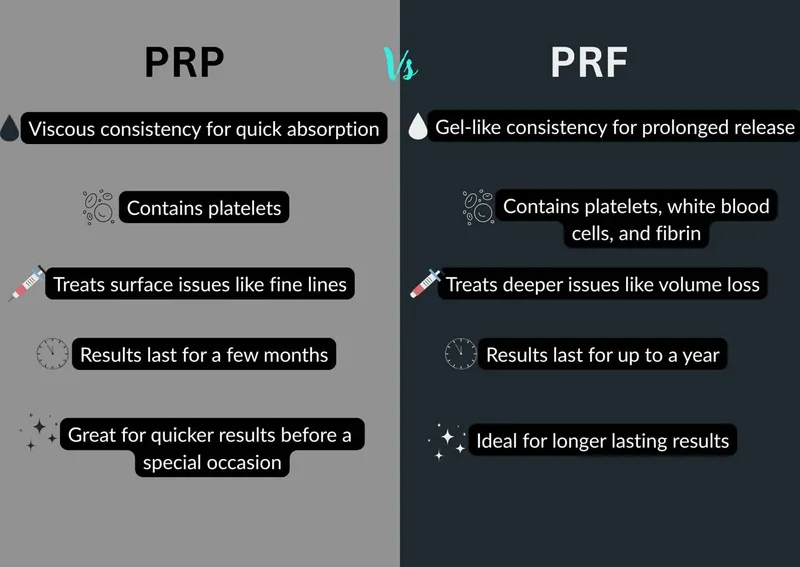
While both PRP and PRF involve spinning a blood sample in a centrifuge machine, they do this at different speeds. PRP spins the blood at a faster rate, with an anticoagulant to prevent clotting, and PRF involves spinning the blood slowly. This enables the formation of a fibrin matrix, which is essential for achieving a slower, more prolonged release of beneficial growth factors.
It contains more components
PRP injections mainly consist of platelets, while PRF includes white blood cells and fibrin. These additional components can help to enhance its regeneration qualities. Since PRF is more concentrated than PRP, this maximises its benefits in skin and hair treatments.
Research reflects this. A study in Dermatologic Therapy found that both PRP and PRF were effective in treating many skin conditions. However, PRF performed better than PRP, specifically when it came to encouraging smoothness and treating wrinkles.
It offers a gradual release of growth factors
During treatment, PRP releases growth factors within a few hours, which can jumpstart the healing process. However, this quick release doesn't last for a long time, which is why frequent PRP treatments are required.
By comparison, PRF injections are longer-lasting. PRF's fibrin matrix provides a more sustained release of growth factors that occurs over a few days to a few weeks. This gradual release is one of the reasons why it's a more effective treatment for tissue regeneration and healing.
It works best for increasing volume
While both PRP and PRF can be used to treat different skincare conditions, PRF offers enhanced tissue regeneration. It has an edge over PRP because it restores volume while enhancing tissue regeneration. This is because of two important features:
- It has a gel-like texture that makes it easier to hold onto the growth factors and ensure they stay in place when injected into the skin.
- Its fibrin matrix works as a scaffold, enabling more collagen remodelling and longer-lasting skin rejuvenation.
Combining PRP and PRF Treatments with Microneedling for Skin Rejuvenation
Even though you can use PRP in conjunction with other cosmetic treatments, you might not get as much of your desired results compared to using PRF. Also, it won't provide the regenerative effects that you might be after.
For example, if you're having wrinkle reduction treatments or microneedling procedures, PRF can offer benefits such as promoting tissue regeneration for optimal results. When using PRF after a microneedling treatment specifically, the PRF penetrates deeper into the skin's dermal layers because of the tiny channels made in the skin from the microneedling. This combined treatment can help you to boost both treatments' skin-rejuvenating effects.
A study in the Archives of Dermatological Research, which looked at acne scar treatment effectiveness, compared the use of PRP and PRF. When both treatments were provided in combination with needling, a group of participants that had the PRF treatment alone or with needling showed more skin improvement than the group being treated with PRP.
PRP vs PRF: Which Treatment Should You Choose?
When to consider PRP:
- If you want faster results, such as achieving a glowing complexion before an important occasion, or you require speedy treatment for a post-operative condition.
- If you want to treat surface issues, such as fine lines and mild acne scars.
When to consider PRF:
- If you want to achieve longer-lasting results, with fewer treatment sessions.
- If you're looking for facial rejuvenation because it adds volume. As we age, we lose our elastin and collagen which can cause volume loss in areas of the face, such as the under-eye area or cheeks. Nonsurgical PRF treatments are an effective way to revitalise the face.
Choosing between PRP and PRF treatments depends on various factors, such as your health, the depth or complexity of the skin condition you're treating, and personal preferences. This is why it's important to consult with an experienced cosmetic doctor, such as Dr. Rakib Uddin at Aesthetics Doctors Australia, who has lots of experience in treating patients with PRP and PRF.
Dr. Rakib is also experienced in combining PRF treatment with micro needling to treat various skin concerns, such as:
- Fine lines and wrinkles
- Acne scars
- Pigmentation
Final Thoughts
Both PRP and PRF injections provide many benefits, and they're quite similar, but PRF is a more advanced treatment to consider if you want to revitalise your skin or hair.
If you'd like to know more about these treatments or go for a session, book a consultation with Dr. Rakib Uddin at Aesthetic Doctors Australia. Get expert guidance on PRP and PRF treatments for skin, hair, and under-eye rejuvenation. You can book a consultation by calling 0451 670 083 or making an appointment online.
Frequently Asked Questions
PRF vs PRP for under-eye rejuvenation: Which treatment is best?
Both PRF and PRP can be used for under-eye rejuvenation. However, PRF is considered optimal because it delivers long-lasting results, adds volume that still looks natural, and encourages tissue regeneration.
Can PRP or PRF treatments be done while pregnant?
PRP and PRF aren't recommended during pregnancy due to the potential risk of infections. There is limited safety data on the use of these treatments during pregnancy, so you should wait until after giving birth before considering them.
Is PRF safe for all skin types?
Yes, PRF is safe for all skin types and tones, even if your skin is sensitive, because it is made from your own blood.
Sources:Archives of Dermatological ResearchDermatologic Therapy