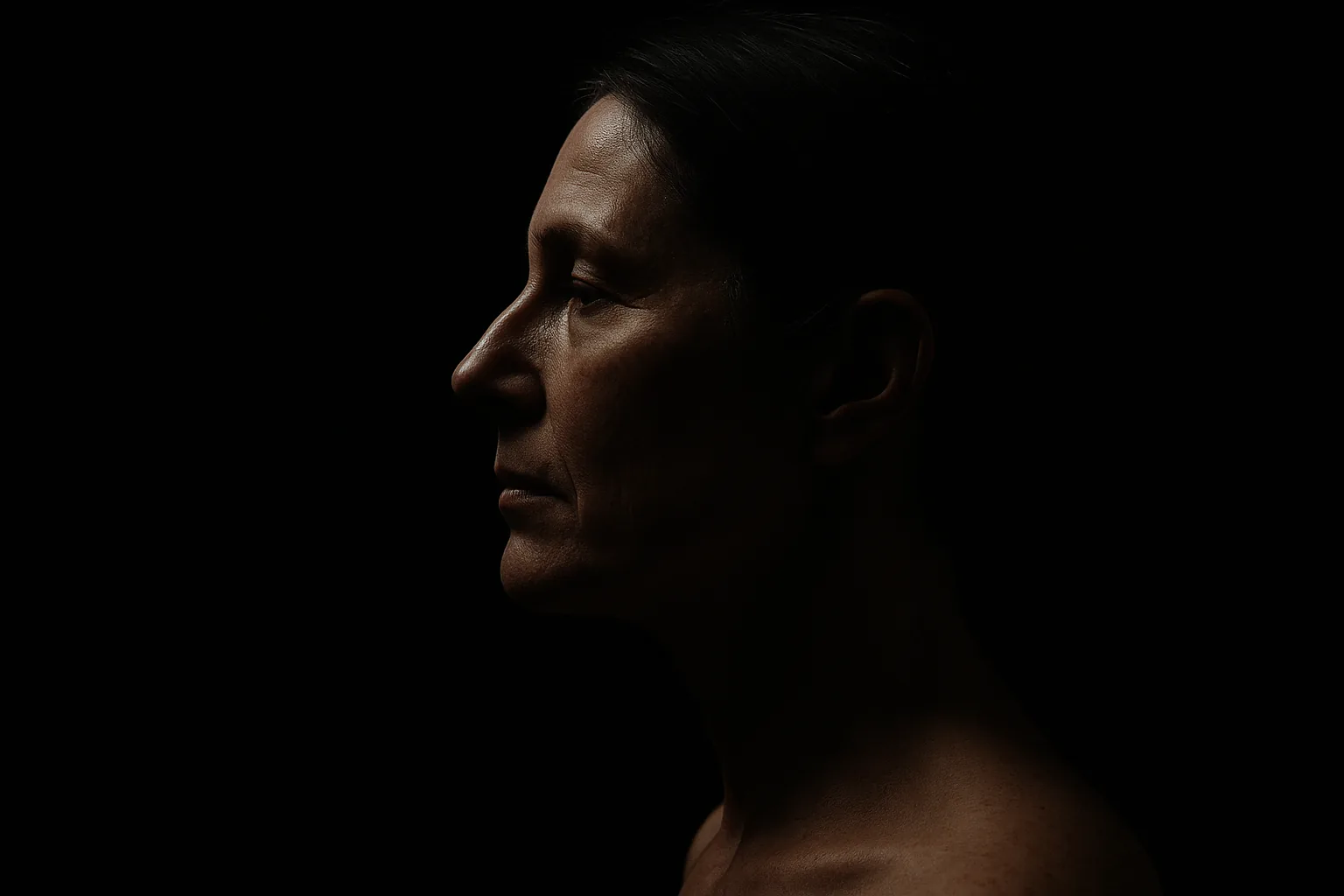
If your lower face looks softer than you would like, the first question is not which treatment to book. It is which of four separate things you are actually looking at: a chin that does not come far enough forward, a jaw border that has lost its edge, a chewing muscle that has grown wide, or skin that has loosened over the top of all of it. They look similar in the mirror and they need entirely different work, which is why two people who describe the same concern in the same words can leave a consultation with two different plans.
The distinction matters commercially as well as clinically. Chin work and jawline work are priced, planned and placed differently, and treating the wrong one is how people end up spending money on a result they cannot see.
Look at your profile, not the mirror
Most people assess their lower face straight on, which is the one angle that hides the answer. The chin is a profile feature. Turn fully side on in a photograph, taken at eye level rather than from above, and the question becomes visible: does the chin point reach the line your nose and lips set, or does it sit behind it?
The jawline is the opposite. It shows itself in a three quarter turn and from slightly below, where you can see whether there is a readable border between the jaw and the neck, or whether the two run into each other.
Take both photographs before you decide anything. Front on, relaxed, no smile; then side on; then a three quarter turn. Natural light, no filter, phone held at eye level. That is the same set of views an assessment starts from.
Signs it is the chin
A chin problem is a problem of projection, which is how far forward the chin comes. The usual signs are:
- Side on, the chin point sits behind the plane your lips and nose suggest it should meet.
- The lower lip looks fuller or more forward than the chin below it.
- The neck looks short or full even though you are not carrying weight there, because a chin that sits back gives the skin beneath it nowhere to tension against.
- A jawline that reads as weak everywhere, not just at one point, because the chin anchors the whole lower face and the jaw borders run back from it.
This is the group the clinic's chin work is built for: structured filler placed on and around the chin point to build forward projection in small, deliberate millimetres, checked side on at every step. The concern itself is set out on the weak and recessed chin page.
One limit belongs here, plainly. Where the recession is skeletal in scale, or the bite is significantly involved, the right recommendation is a surgical or orthodontic pathway rather than an injectable one, and that is what Dr Rakib will say.
Signs it is the jawline
A jawline problem is a problem of edge. The chin may be perfectly well positioned and the border still fails to read:
- The jaw line is visible at the chin and again near the ear, but blurs in the middle.
- There is a hollow just beside the chin, in front of where a jowl sits. This is the pre jowl sulcus, and it breaks the line more than its size suggests.
- One side is more defined than the other.
- The angle near the ear has flattened, so the lower face reads as rounded rather than cornered.
This is contouring along the jaw rather than building at the chin, and what that involves is set out here. Where the softening is a hollow and a loss of support rather than loose skin, it responds to volume placed along the border. Where collagen and elastin have thinned, a collagen biostimulator built on calcium microspheres works more slowly and in a different way, stimulating the skin's own collagen rather than filling a space.
When it is the muscle, not the structure
A lower face can also be wide rather than undefined, and that is a third thing entirely. The masseter is the chewing muscle on either side of the jaw, and it enlarges with use: clenching, grinding, and the jaw tension that comes with temporomandibular joint problems. A grown masseter widens the face at exactly the point people want narrowed, and no amount of filler will narrow it, because the problem is bulk rather than absence.
The giveaway is tenderness. Press the muscle just in front of the ear and clench. If it is sore, firm or noticeably large, and especially if you wake with a tight jaw or headaches, read the page on treatment for jaw tension and a wide lower face. Relaxing the muscle slims the face as a side effect of treating the clenching.
When it is skin rather than any of them
The fourth case is laxity. Skin loses elastin and collagen with age, the fat pads of the lower face shrink and move downward, and bone density in the jaw and cheek reduces, often noticeably around menopause. The result is a jawline that was once defined and no longer is, and the softening sits on top of the border rather than in it.
Filling a lax jawline as though it were a hollow one is the most common way to make a lower face look heavier rather than sharper. Where skin is the limiting factor, lifting and tightening approaches come first. The question is taken on at length in the article on treating jowls without surgery, and the concern page for jowls and lost jaw definition sets out which pathways apply.
Why the distinction changes the plan
Four problems, four different answers:
| What you are looking at | What it needs |
|---|
| Chin sits behind the profile line | Projection built at the chin point, planned side on |
| Border blurs or hollows beside the chin | Volume or collagen stimulation along the jaw border |
| Lower face is wide and the muscle is tender | The chewing muscle relaxed, which treats the clenching too |
| Skin has loosened over a once defined jaw | Lifting and tightening before any volume |
More than one can be true at once, and usually is. A chin that sits back and a jaw border that has softened are a common pair, and treating only one leaves the result looking incomplete. That is a sequencing decision rather than a choice: which comes first, and how much, and what the second one is still for once the first has settled.
What a consultation settles
Three things you cannot settle from a photograph. Whether the chin recession is soft tissue or skeletal, because that decides whether an injectable is appropriate at all. How much projection the profile can take before it stops looking like you, which is judged in millimetres and side on, not by a number agreed in advance. And whether your skin will hold what is placed, because volume put under skin that cannot support it migrates and drops.
Dr Rakib Uddin is a Fellow of the Australian College of Cosmetic Surgery and Medicine and taught anatomy before practising aesthetics, and assessments at the Kew clinic in Melbourne start from the whole profile rather than the feature you came in about. If you would like your own lower face read properly, you can arrange an assessment.
Volume placed in the chin or along the jaw commonly lasts between twelve and twenty four months, depending on the product used and on individual factors such as metabolism and sun exposure. Results vary from person to person and nothing here is a guarantee of outcome; this article is educational and personal advice always requires assessment.
Frequently Asked Questions
How do I know if I have a weak chin or a weak jawline?
Look at a side on photograph taken at eye level. If the chin point sits behind the line your nose and lips suggest, it is a chin projection question. If the chin is well positioned but the border between jaw and neck blurs in the middle or hollows beside the chin, it is a jawline definition question. Many people have some of both.
Can one treatment fix both the chin and the jawline?
They are usually treated in the same appointment but they are not the same treatment. Projection is built at the chin point and definition is built along the jaw border, with different amounts, different placement and different endpoints. What is shared is the plan, which is why both are assessed together rather than separately.
Will chin filler make my face look longer?
Projection built in small increments and checked side on at each step changes how far forward the chin comes rather than how long the face is. The plan stops at balance rather than at maximum, which is the point of checking from the side throughout rather than only at the end.
My lower face is wide rather than undefined. Is that the same problem?
No, and it is worth separating. A wide lower face is often an enlarged chewing muscle rather than a structural one, particularly if you clench or grind or wake with a tight jaw. That is treated by relaxing the muscle, not by adding volume, and adding volume to it would make the width more obvious.
How long should I wait before deciding whether it worked?
Swelling after lower face treatment settles over the first week or two, so the shape you see on the day is not the result. A collagen biostimulator works on a longer timeline again, because it stimulates your own collagen rather than filling a space, and is reviewed over months rather than weeks.